AI Readiness Assessment for Enterprise Legal Teams
Trust in AI output, not access to it, separates legal programs that work from expensive failures.
AI readiness for enterprise legal teams is not a technology question. It is a diagnostic across data maturity, process clarity, governance, and change readiness, and most legal departments score unevenly across those dimensions even as adoption climbs at a pace few functions have seen before. This article lays out a structured way for legal leaders to assess where they actually stand, and what needs fixing before anyone commits budget to deploying AI at scale. Legal AI has moved from experiment to expectation faster than most departments have built the infrastructure to support it.
The numbers back that up. A separate ACC and Everlaw survey found corporate legal adoption more than doubled in the same window, climbing from 23% in 2024 to 54% in 2025.
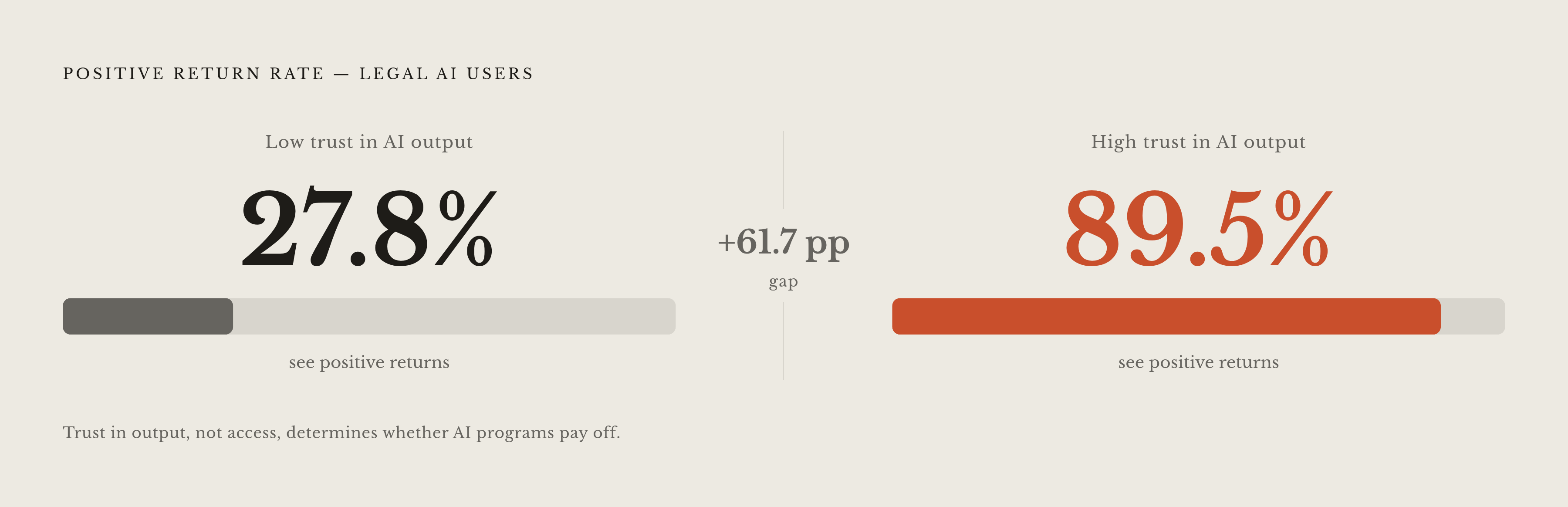
Only 23% of in-house lawyers use AI daily, and 27% had not used it in the prior six months, per Bloomberg Law's State of Practice survey based on 760 practitioners. Trust tracks the same divide: just 22.1% of legal AI users report high trust in the output, yet the teams with high confidence in their tools saw positive returns at 89.5%, compared to 27.8% among low-trust teams, according to Legaltech News reporting. That is not a rounding error. It is a signal that trust, not access, is what separates AI programs that pay off from ones that just generate activity.
None of this happens in a vacuum of slack demand. Thomson Reuters CEO Steve Hasker has framed 2026 as the year a real divide emerges, between organizations that commit to an AI strategy and those that don't. That's not a marketing line. It's a description of where the stakes sit right now: high adoption paired with low readiness is a predictable setup for expensive failure, and the rest of this piece is built to help legal teams get ahead of it. 87% of GCs now report using generative AI within their teams, nearly doubling from 44% just one year earlier, a finding from the FTI Consulting and Relativity General Counsel Report, which was based on 224 GCs/CLOs at organizations with $100M+ revenue plus 30 in-depth executive interviews Future Ready Lawyer 2026: Building confidence for legal enterprises i…. Structural demand pressure makes inaction costly, as 63% of legal departments cite workload and bandwidth as their top challenge, while 83% expect demand to keep growing, per the CLOC 2025 State of the Industry Report.
Why most enterprise AI programs stall before they scale
Start with the failure rate, because it's the anchor for everything that follows. MIT NANDA's "GenAI Divide: State of AI in Business" study found that roughly 95% of enterprise generative AI pilots deliver no measurable impact on profit and loss, with only about 5% crossing into genuine operational or financial return. That is not a story about weak models. It's a story about integration, data, and workflow design, and legal leaders should resist the temptation to file it under "tech industry problem" and move on.
The pattern holds well beyond software companies. Infomineo's research, drawing on BCG and MIT Sloan data from 2024, found that 80% of AI initiatives across industries fail to deliver their intended business outcomes, and the most common root cause is starting deployment without an honest picture of where the organization actually stands Svitla Systems. Three structural failure modes appear repeatedly. Organizations confuse capability with readiness, assuming that having the infrastructure means the operating model and governance are aligned behind it. They run assessments with no external benchmark, producing a score that confirms what leadership already believed instead of challenging it. And they treat readiness as a single snapshot, even though the pace of change in this space makes a six-month-old assessment functionally obsolete.
Gartner's 2025 research adds a sharper point still: fewer than 30% of organizations that complete a self-administered AI readiness exercise actually use the results to change investment priorities. Self-assessment, in other words, is necessary but nowhere near sufficient without independence and rigor built into how it's scored.
Legal teams face all three failure modes, plus something most functions don't carry: privilege, confidentiality, and regulatory exposure that turn an ordinary deployment misstep into a client-facing liability. Getting the diagnostic wrong doesn't just waste a pilot budget in legal. It can waste privilege. That's the case for a structured assessment across defined dimensions, not another vendor bake-off dressed up as due diligence.
The six dimensions a real AI readiness assessment covers, and the two most legal teams underweight
The Infomineo research lays out a structured diagnostic across six dimensions: strategy, data, technology, talent, governance, and research capability, each measured against defined maturity benchmarks to produce a scored baseline and a prioritized gap analysis. Strategy and vision alignment asks whether AI objectives actually tie to business outcomes, with executive sponsorship and resource allocation that carries milestone accountability, rather than existing as a slide in a board deck. Data infrastructure and quality asks not whether data exists, but whether it's accessible, labeled, governed, and fit for the specific use case at hand. Technology and architecture covers cloud infrastructure, API readiness, and integration capacity, the plumbing that determines whether a model can actually be deployed and iterated at business speed. Talent means technical capability plus AI fluency spread across business functions, not concentrated in a single data science team sitting apart from the work. Governance and ethics covers the policies, oversight mechanisms, and accountability chains that should be at board or executive level. Research capability, the dimension most organizations underinvest in, is the ongoing discipline of tracking AI benchmarks and stress-testing the business case as the technology moves.
Governance is a gap: 45% of business leaders report lacking clear AI governance guidance at their organization, according to BCG's research, and it's the most common gap that self-administered assessments simply fail to surface. Data quality is the second, and the scale of the mismatch here is striking.
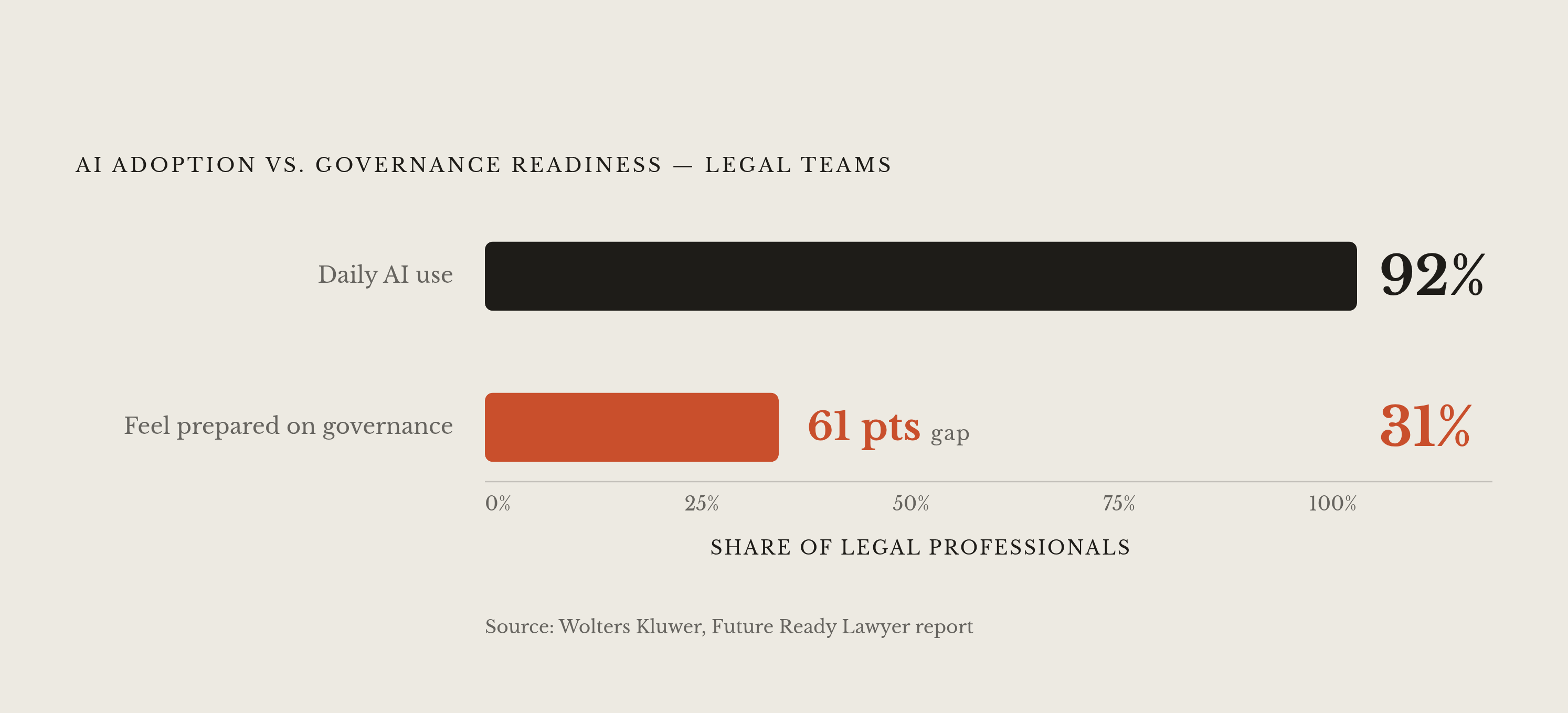
That gap is not visible in a self-assessment that skips external benchmarks and stakeholder validation. Frameworks run without that rigor tend to produce reassuring slide decks while the real gaps remain untouched, according to Infomineo's findings. The six dimensions apply across every industry running an AI program. What follows is how they translate specifically to in-house legal work. The two dimensions most commonly underweighted in legal are identified below. On data quality, 92% of legal professionals report using AI daily according to the Wolters Kluwer Future Ready Lawyer report, yet only 31% feel prepared regarding information security and governance (a 61-point gap between usage and readiness) Wolters Kluwer 2026 Future Ready Lawyer series.
Running a legal-specific readiness assessment across data, process, governance, and change readiness
Generic enterprise AI criteria need re-calibration once privilege, confidentiality, regulatory obligation, and workflow specificity enter the picture, and that recalibration is where a legal readiness assessment actually earns its keep.
Start with data maturity. The core question isn't whether contract and matter data exists somewhere, it's whether it's accessible, labeled, and governed as an asset. Are contracts sitting in machine-readable formats, or locked away in PDFs and legacy repositories nobody's cleaned up in a decade? Is there an actual governance policy covering who can access legal data and how it's retained? And before any vendor gets near a signature, one question has to get asked directly: does this platform train shared models on customer contract data? That's a line that should never get crossed. Using client contract data to train a model shared across other customers is a confidentiality and privilege risk, full stop, not a negotiable feature. As one Wolters Kluwer panel put it during the Future Ready Lawyer series, AI is only as good as the data behind it, and legal departments need to check whether that data is complete, clean, readable, and free of bias before they trust output built on top of it.
Process clarity comes next. The question is which workflows are standardized enough for AI to operate inside them, and which carry too much variation or too much discretionary judgment to hand over. Contract review is the clearest fit: 52% of in-house legal teams already use or are evaluating AI for the task, 87% say AI would benefit contract review and redlining specifically, and average review time still runs 3.1 hours per contract, according to a survey of 452 in-house legal professionals from LegalOn and In-House Connect. But readiness here hinges on documentation. Does the team have written playbooks, fallback positions, and risk tolerances an AI system can actually operationalize, or does that knowledge live only in the heads of a handful of senior lawyers? Undocumented judgment can't be encoded into a guardrail, which makes the absence of documentation a readiness gap in its own right, not a minor workflow inconvenience.
Governance readiness is the third pillar, and it deserves more scrutiny than most self-assessments give it. Is there a named executive sponsor for AI with a real twelve-month roadmap and milestones someone is accountable for? Are approved tools actually defined, or is each lawyer quietly sourcing their own subscription? Are human checkpoints built into the workflow by design, rather than bolted on after something went wrong? And critically: does the governance model account for agentic AI, systems that can plan tasks, invoke other tools, reach into internal systems, and take action across a workflow with limited human intervention? Reporting from the PLI Chronicle in March 2026, carried by Lexology, makes the point: policies built for static, decision-support tools don't translate cleanly to systems that act on their own. This isn't theoretical risk. By late 2025, researchers had already tracked more than 120 court cases worldwide involving AI hallucinations, which means verification checkpoints aren't optional add-ons, they're load-bearing parts of the governance framework. For large enterprises, Wolters Kluwer's Future Ready Lawyer research points to a federated model as the workable answer: centralize the guardrails, approved tools, and data rules, and leave operational judgment to the practice groups closest to the work.
Change readiness rounds out the four, and it's the one most likely to get waved through without real scrutiny. AI implementation is a change management effort, not an IT project, as Philipp Eder of Allianz Legal Protection put it during a Future Ready Lawyer 2026 webinar. Do people on the team feel safe testing a tool without penalty when it doesn't work? Have leaders actually helped people redefine what their professional identity looks like as the tasks they perform shift underneath them? Does leadership treat cultural transformation as a prerequisite for AI deployment, rather than something to patch in after the fact? Half of AI-using companies plan to reskill a significant share of their workforce within three years, according to Svitla's analysis of McKinsey data, and legal teams need a people strategy running parallel to the technology strategy, not trailing behind it Svitla Systems. Before any of this reaches a vendor conversation, one filter should come first: was the tool built for in-house legal specifically, or is it a general AI platform with a legal skin stretched over it? That distinction shapes privilege protection, vocabulary, workflow fit, and output accuracy in ways that are hard to reverse once a contract's signed.
Where enterprise legal teams most commonly score unevenly
A clear pattern runs through the research: legal teams tend to score well on technology adoption and tool access, and score poorly on governance, data quality, and change readiness, which happen to be exactly the dimensions that decide whether AI scales or quietly stalls out.
Governance is the widest gap. Data quality sits right behind it, and the gap is structural rather than a matter of effort. Data scientists across industries spend somewhere between 60% and 80% of their time on data preparation instead of model development, according to Anaconda's State of Data Science Report, and in legal that appears as contracts that are stored but never structured, metadata that's missing, and playbooks that exist only informally Svitla Systems.
Change readiness is the cultural gap. Legal teams are trained for precision and caution, traits that serve clients well in the courtroom and slow down experimentation everywhere else. Without psychological safety and some honest work on professional identity, even a well-governed AI deployment sees weak adoption. Strategy alignment rounds out the picture: only 21% of companies have actually redesigned workflows to integrate AI effectively, per McKinsey data cited by Svitla, and legal teams frequently roll out a tool without tying it to a workflow redesign or a specific business outcome target.
The consequence of scoring unevenly across these dimensions is not academic. Teams strong on one axis and weak on another routinely mistake tool deployment for readiness, and they find out how wrong that assumption was only after a pilot fails or a compliance incident forces the issue. Scoring unevenly is normal. The real diagnostic value sits in identifying which gap to close first, not in chasing uniform maturity across every dimension at once. Governance is the most common gap, with 45% of business leaders lacking clear AI governance guidance according to BCG, while in legal specifically, only 31% feel prepared on information security and governance despite 92% daily AI use, per Wolters Kluwer Wolters Kluwer 2026 Future Ready Lawyer series.
Governance infrastructure for a legal team deploying AI at scale
Corporate legal adoption more than doubled in one year, from 23% in 2024 to 54% in 2025, a finding from an ACC and Everlaw survey. 2026 is the year of accountability, and organizations that haven't built governance infrastructure yet are facing a much harder transition now that AI sits embedded in core workflows rather than off in a sandbox.
Real governance infrastructure for legal AI has a few non-negotiable components. An approved-tools policy that names which AI tools are sanctioned, for which use cases, and under what conditions. Defined human checkpoints specifying exactly where in a workflow a lawyer has to review and confirm before anything gets acted on. Data handling rules covering how contract data moves to and through a vendor, including an explicit, contractual prohibition on that vendor using client data to train shared models. Incident and hallucination response protocols, spelling out what happens when AI output is wrong, how the error gets caught, and how it's corrected before it does damage. And audit trail requirements, so that any AI-assisted decision can be reconstructed and explained if it's ever challenged.
For large enterprises, the federated model from Wolters Kluwer's Future Ready Lawyer 2026 research is the practical shape this takes: centralize the guardrails, approved tools, data rules, audit requirements, and let individual practice groups or business units own the day-to-day judgment calls within those boundaries. Centers of Excellence function as governance infrastructure in their own right here. Organizations that have a center of excellence running, a recognized risk framework adopted, and their AI landscape actually mapped are positioned to adapt as the technology keeps moving, and that positioning is a maturity milestone worth treating seriously, not a luxury reserved for the largest legal departments.
Agentic AI changes the governance posture required, because. Systems that plan tasks, invoke tools, reach into internal systems, and take action across a workflow with limited human intervention cannot be governed by policies written for simple prompt-and-response tools. Governance has to specify the scope of permitted action, the triggers that force escalation to a human, and the audit requirements for every autonomous step the system takes, a point raised in PLI Chronicle reporting carried by Lexology. Ownership matters as much as content here: 28% of organizations report that their CEO personally oversees AI governance, and that level of oversight correlates with the strongest financial outcomes, per Svitla's research. For legal, the equivalent is straightforward. Governance belongs to the GC or CLO directly. It should not get delegated down to IT and forgotten about.
None of this is abstract anymore in procurement terms, either. Governance now appears in the first 90% of CLM RFPs in regulated industries in 2026, which means the buyer's question has shifted from "does it have AI" to "is the AI explainable, auditable, and aligned with how we actually work".
How contract intelligence platforms fit into a readiness-driven deployment
Contract review sits at the top of the list for readiness fit. The workflows are repetitive and high volume, the standards can be written down into playbooks a system can follow, the output is verifiable by a lawyer before anything moves forward, and the return on investment is easy to see rather than something a vendor has to argue for.
That level of consensus is rare in legal tech, and it says something real about where the readiness dimensions above actually line up: data that can be structured, process that can be codified, governance that can specify a clear human checkpoint at the review stage.
None of that means every contract intelligence platform deserves equal trust, though. The evaluation still has to run through the same readiness lens laid out earlier in this piece: does the platform train on customer data, does it support the audit trail a legal department needs if a decision gets challenged later, does it fit the vocabulary and workflow of in-house legal specifically rather than sitting on top of a generic AI layer, and does it support the human checkpoints a governance framework requires rather than trying to route around them. A platform that scores well on all four is one built for the readiness legal teams actually need, not just the adoption numbers everyone's already chasing. 52% of in-house legal teams are already using or evaluating AI for contract review, with active usage nearly quadrupling since 2024, and 87% say so.
Sources
- Future Ready Lawyer 2026: Building confidence for legal enterprises in an AI era
- AI Readiness Assessment: A Practical Framework for Enterprise and Consulting Teams
- AI Readiness & Implementation Guide 2026 | Svitla Systems
- Agentic AI Readiness: A Practical Checklist for Enterprise Teams - Lexology
- In-House Legal Teams Brace for AI-Fueled Transformation in 2026