Change Management for AI Rollout in Legal Departments
Governance gaps threaten to undermine rapid AI adoption across legal departments.

Adoption of generative AI in legal departments nearly doubled in a single year, and the governance built to manage it did not. That gap, not the technology itself, is the real story of AI in legal right now, and change management is the discipline that closes it.
The numbers make the pace hard to dispute. The FTI Consulting/Relativity General Counsel Report, surveying 224 general counsel, found 87% now report generative AI use within their teams, up from 44% just a year earlier. Separate research from blog.platinumids.com puts legal professional adoption at 69% in 2026, up from 31% in 2025. The ACC/Everlaw GenAI Survey tells the same story from a different angle: corporate legal AI adoption jumped from 23% to 52% in one year. Rapid adoption, on its own, is not transformation. It's installation without infrastructure, and the difference between the two is what determines whether any of this sticks.
The same data set shows the infrastructure gap: firms lack training and formal policy even as individual adoption races ahead. blog.platinumids.com found that 54% of firms offer no AI training at all, and 43% have no formal AI policy. Individual lawyers and legal ops staff have raced ahead on enthusiasm, opening tabs, running pilots, testing tools against real work. Institutions have not caught up. That gap between what individuals are doing and what the organization has actually built to support it is precisely the terrain change management exists to work on. Institutional readiness, in this context, means governance, training, workflow redesign, and a cultural shift in how lawyers relate to the tools, not simply picking a vendor and issuing licenses. None of this should read as crisis. It's a structural lag, the kind every technology transition produces, and it only becomes a problem if nobody manages it on purpose.
Why AI adoption in legal is a transformation exercise, not a procurement exercise
The most common failure mode in legal AI right now is treating the whole thing as a vendor selection problem. A team runs a formal vendor selection process, picks a tool, runs a pilot, and then can't explain why adoption stalls the moment the pilot ends. swiftwaterco.com reports that this pattern repeats across corporate legal departments: teams engage AI as a procurement decision when the actual work in front of them is a transformation exercise. The tools themselves are table stakes at this point. What separates departments that keep generating value from those that plateau after a promising pilot is whether leadership treats AI as a change to how the function operates, not just a change to which software sits on someone's desktop.
This reframe is being driven by mounting workload and budget pressure documented in industry data. The CLOC State of the Industry Report found 63% of legal departments cite workload and bandwidth as their top challenge, and 83% expect demand to keep climbing. The 2026 State of the Corporate Law Department Report adds a budget dimension: 81% of departments report increasing matter volumes, while 55% face flat or shrinking budgets. Put those together and AI stops looking like a nice-to-have and starts looking like the only lever left, since headcount alone cannot absorb the volume increase most departments are already living through.
Four components anchor the transformation framing, and each gets its own treatment later in this piece: defining the actual problems worth solving, building governance before scaling anything, measuring the right things instead of the easy things, and connecting AI adoption to the broader story a general counsel tells about legal's role inside the business. The stakes on getting this sequence right are rising fast, too. PYMNTS reporting found that AI agents are already reviewing contracts, monitoring regulatory change, and handling first-pass discovery in live production environments. The live question for most departments is no longer whether to deploy agentic AI. It's how to govern what's already running.
Building governance before you scale, the sequence most teams get wrong
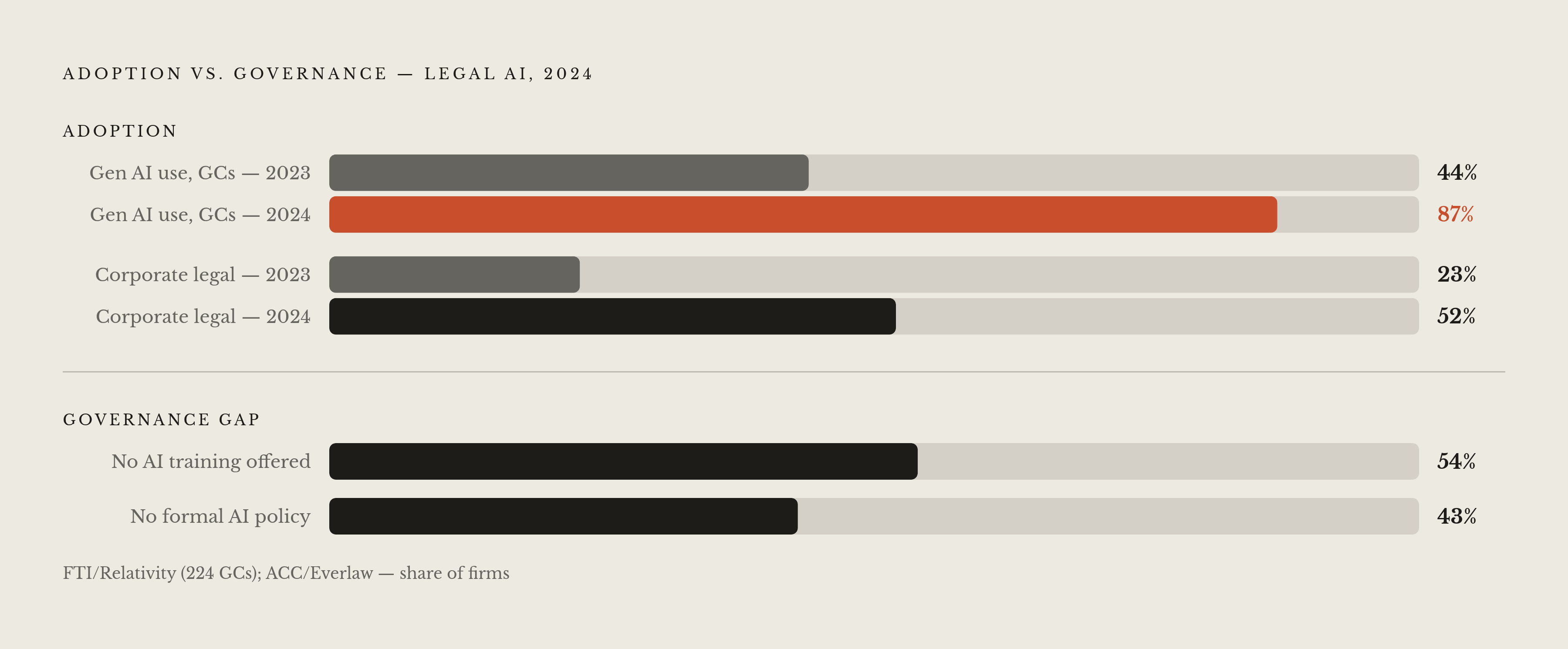
Most legal departments select a tool, pilot it on a narrow task, and only discover the governance holes once something breaks at scale. That ordering is backwards, and it's the single most common sequencing mistake in legal AI rollouts today.
Progress on formal planning is real but still partial. FTI/Relativity's data shows legal departments with a formalized technology roadmap hit an all-time high of 53%, more than double the 25% recorded the year before. That's real movement, but it still means nearly half of all legal departments are scaling AI without a documented roadmap governing how it happens. Before any team scales past a pilot, governance needs to cover acceptable use, human-in-the-loop requirements that vary by task type, auditability standards, vendor risk assessment, and data privacy rules that hold up under scrutiny.
The regulatory floor under all of this is rising, and it is no longer optional reading. ABA Formal Opinion 512, issued in July 2024, requires lawyers to maintain a "reasonable and current understanding" of what AI tools can and cannot do. Dozens of federal and state judges have issued standing orders requiring disclosure and independent verification of filings prepared with the help of these tools. The EU AI Act reaches general application in August 2026, bringing transparency obligations under Article 50, though the heavier high-risk system obligations are staggered out to December 2027 for Annex III systems; the maximum penalties, up to €35 million or 7% of global turnover, apply to prohibited practices rather than high-risk violations, which top out at €15 million or 3%. AI use in legal services falls within the Act's scope. Domestically, Colorado's Automated Decision-Making Technology Act takes effect January 1, 2027, and Illinois's AI in Employment law takes effect January 1, 2026. National Law Review reporting found that until courts settle the federal-state standoff on AI preemption, the most restrictive jurisdiction's requirements effectively set the floor for everyone operating nationally.
Accountability has already been settled in practice, even where the law is still unsettled. When courts sanction lawyers for hallucinations produced by one of these tools in filings, the sanction lands on counsel, regardless of which department chose the tool or how convincing the vendor's accuracy claims were. That risk doesn't distribute itself evenly across an organization; it concentrates on the lawyer who signed the filing.
Governance structure isn't one-size-fits-all, and departments tend to land on one of three models. A centralized model, a single AI Governance Committee with authority over every deployment, buys consistency but risks becoming a bottleneck the moment demand outpaces the committee's bandwidth. A federated model lets business units own their own use cases within enterprise standards, trading some consistency for speed. the model most departments appear to have settled on by 2026 is hybrid: centralized policy and risk appetite, paired with federated execution at the team level.
Auditability deserves treatment as a design requirement, not an afterthought bolted on later. Elevate's research found that flagging a contract deviation or an invoice anomaly is only useful to a reviewing lawyer if the AI's rationale is presented clearly alongside the flag. A tool that presents a conclusion without the reasoning behind it asks the lawyer to trust a black box, which is precisely the posture ABA Opinion 512 asks lawyers to avoid. And data privacy in this context is a governance question first, not a vendor checkbox to tick during procurement. Legal contracts hold some of the most sensitive commercial data anywhere in an organization: pricing terms, liability caps, negotiation history. Any platform touching that data needs to meet the highest standard available, and using a client's or customer's contract data to train a shared model is a line no department should cross.
Governance, treated properly, is not a document that gets ratified once and filed away. It's a function. It needs an owner, a review cadence, and an escalation path for when something doesn't fit the policy as written, because something eventually won't.
Designing training that changes how lawyers work
Training is where the gap between adoption and readiness is most visible. blog.platinumids.com found that the 54% of firms offering no AI training at all isn't a minor lag behind best practice. It's a structural absence, and it explains a lot of the inconsistent, ad hoc AI use visible inside departments that otherwise look sophisticated on paper.
Standard software training fails for AI tools because the skill being taught is fundamentally different. A feature walkthrough teaches someone where the buttons are. AI use demands judgment: when to trust an output, when to push back on it, when to escalate instead of proceeding. That's not a training problem software vendors are built to solve, and departments that treat AI onboarding like a CRM rollout will produce lawyers who click through the tool without ever developing the judgment to use it well.
Effective training covers ground that goes beyond the interface. It needs to explain what the tool does and does not do, including specific failure modes like hallucination, so lawyers aren't caught off guard the first time output looks confident and wrong. It needs to draw a clear line between tasks appropriate for AI-first handling and tasks that require lawyer-led judgment from the outset, not as an afterthought. It has to teach lawyers to read and verify output rather than accept it at face value, which is the practical, day-to-day expression of the "reasonable understanding" standard ABA Opinion 512 sets as a professional obligation. And it needs to teach lawyers how to give useful feedback that actually improves the tool's performance over time; feedback loops on accuracy are the center of any AI program that improves rather than stagnates.
Tommie Tavares-Ferreira, chief strategy officer at Lawtrades, said directly in comments to Bloomberg Law: the legal teams that get the most out of AI will be the ones with "thoughtful lawyer-in-the-loop design." That phrase does real work. It means a department has to say out loud, in writing, exactly when judgment is required and how it gets applied, rather than leaving it to individual instinct.
Training also has to differentiate by role. What a contract attorney needs to know about a clause-review tool is not what a legal operations manager or a general counsel needs to know about the same tool. One-size training produces surface-level compliance, people who can say they completed the module, without producing anything resembling real capability. And the spark that actually drives adoption tends to be concrete rather than conceptual: Wolters Kluwer's Legal Leaders Exchange podcast reported that clients say seeing AI perform an actual task, not hearing an abstract description of its capabilities, is what moves teams from curiosity to use.
The most durable version of training embeds itself into the first real workflows a team runs, rather than existing as a separate course delivered before anyone touches the tool. And the most effective trainers, in practice, tend to be the early adopters already inside the team, the paralegal or junior associate who figured out a workflow trick and can show a peer in five minutes what a vendor's onboarding deck would take an hour to explain badly. Identifying and equipping those internal champions holds up better over time than leaning on vendor-delivered sessions alone.
None of this works in isolation from governance, either. Training without governance produces inconsistent practice, different lawyers making different calls about the same category of risk. Governance without training is unenforceable, a policy nobody actually knows how to follow. They're the same program wearing two names, not two separate initiatives running on parallel tracks.
How to sequence the rollout, from defined use cases to scaled workflows
The first decision in any rollout isn't which tool to buy. It's which problem actually needs solving. swiftwaterco.com found that teams that start with tool selection and then retrofit a use case around it tend to underperform teams that name the problem first and let the tool selection follow from that.
The workflows already generating measurable value in legal departments cluster around a few areas. Contract review, specifically summarization, clause deviation analysis, and alternative language suggestions benchmarked against standard negotiating positions, leads the pack; per FTI/Relativity, 83% of departments are using or experimenting with summarization, and 63% are using clause identification tools. Invoice and billing review is close behind, where AI flags outside counsel guideline violations and unusual billing patterns, filters the invoices that are clearly compliant, and routes human attention toward the ones that actually need expert judgment. Matter intake is a third area, where conversational AI is replacing rigid intake forms and surfacing similar past matters to guide the requester.
The documented gains in contract lifecycle management specifically are substantial. National Law Review reporting found that AI integration in CLM has already cut contract cycle times by up to 40% in deployments on record, and Gartner projects companies using AI in CLM can cut contract review time by as much as 50%. Contracts make a strong starting point for a deeper reason than speed, too: a contract portfolio is not just a stack of documents waiting to be reviewed. It's a repository of institutional knowledge, every risk position the organization has taken, every negotiation pattern, every commitment made to a counterparty. AI that surfaces that intelligence across the whole portfolio, not just at the moment of signature, is where the strategic value compounds well past the efficiency gain on any single deal.
Rollout plans that get sequencing wrong waste pilot resources and produce unreliable data that undermines the case for scaling. Pilots belong on high-volume, repeatable tasks where errors are catchable quickly and the feedback loop is fast, contract first-pass review and invoice triage fit this description well. Baseline metrics need to exist before anything expands, not get reconstructed afterward from memory. Only once human oversight mechanisms are proven and documented should a department move toward more autonomous workflows, agentic AI handling multi-step tasks, zero-touch contracting for genuinely low-risk agreement types.
The broader pattern emerging across legal departments is instructive here. A common gap exists between widespread individual AI use, lots of people using the tools on their own, and systematic deployment across the function as a whole. Closing that gap required redesigning workflows end to end; the goal wasn't making individual employees faster in isolation, it was making the entire system faster. legal department transformations tend to span four distinct tracks: people, process, data, and technology, treating each as a separate stream of work rather than one undifferentiated "AI project."
The urgency behind getting this right compounds quickly. National Law Review reported that Gartner projects 40% of enterprise applications will feature task-specific AI agents by 2026, up from under 5% just a couple of years prior. Departments that haven't built workflow infrastructure for human oversight will find themselves governing agentic systems already running in production, without the scaffolding to do it safely. And the volume keeps growing on the inside, too: the 2026 State of the Corporate Law Department Report found a significant share of departments expect to bring more work in-house going forward, which means any rollout sequence has to plan for rising internal volume, not just manage the caseload sitting on the desk today.
Measuring impact before the business defines it for you
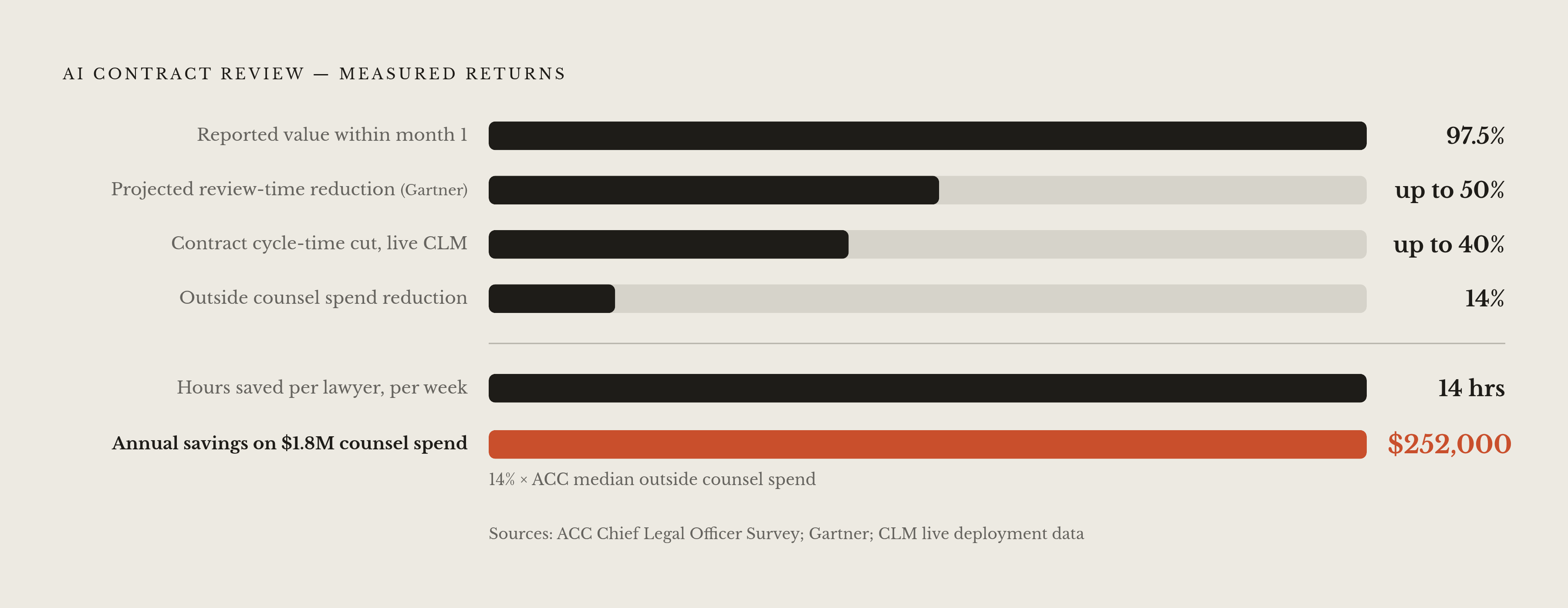
Most legal departments are accelerating output with AI while still lacking the metrics to prove it. That gap between perceived value and demonstrated value is not a minor accounting problem. It's an exposure.
The exposure is already visible in how other parts of the business talk about legal headcount. There is a growing concern among senior in-house leaders that executive leadership in some organizations is already citing AI as justification for headcount reduction before legal has had adequate opportunity to demonstrate value from the tools in question. A team that cannot show its impact in numbers is a team vulnerable to having its story written for it by someone in finance.
The case for measuring well is strong precisely because the returns are demonstrable when tracked properly. GC AI's survey of more than 100 active users found lawyers using AI for contract review report saving an average of 14 hours per week, alongside a 14% reduction in outside counsel spend. Applied against the ACC's reported $1.8 million median in-house outside counsel spend, that 14% works out to roughly $252,000 a year for a median-sized department. Notably, 97.5% of respondents in that survey reported seeing value before the end of their first month of use, which suggests the payback period on well-implemented tools is short.
The measurement framework has to exist before rollout starts, since baselines can't be reconstructed retroactively once a workflow has already changed. Four tracks deserve tracking, mirroring the same structure used in sequencing the rollout itself. On people: AI proficiency by role, time to competence, and adoption rate broken out by workflow rather than averaged across the whole team. On process: cycle time reduction, volume handled without needing escalation, and error rates measured before and after the tool went live. On data: what share of the contract repository has actual coverage, what percentage of agreements carry structured metadata, and how long it takes to answer a portfolio-level question that used to require a manual search. On technology: system uptime, accuracy feedback loops, and how complete the audit trail actually is when someone needs to reconstruct a decision.
The hardest metric to capture is also the one that matters most: how much legal capacity has been redeployed toward higher-value work, as opposed to simply how much time got saved on lower-value tasks. That distinction is the entire difference between efficiency and strategic impact, and it's the one number that a usage dashboard does not capture automatically. FTI/Relativity found 39% of general counsel now count AI among their strategic priorities for legal department efficiency, but a priority only holds weight with a CFO or a board once it travels upward backed by evidence, not sentiment.
Measurement carries a change management function of its own, beyond reporting. Teams that watch their own productivity data improve in real time tend to deepen their use of the tool rather than let it lapse after the pilot. Dashboards, in that sense, aren't just a reporting artifact for leadership. They're an adoption accelerant for the people doing the work.
The cultural shift legal leadership has to drive personally
Some of the resistance to AI in legal departments is really a confidence problem wearing a technology costume. Lawyers build careers on applying precise, defensible judgment to high-stakes decisions, and AI hands them a tool that is probabilistic, occasionally wrong, and not always fully explainable. Without leadership actively normalizing that uncertainty as a manageable feature of the tool rather than a disqualifying flaw, individual lawyers quietly route around the AI instead of learning to work through it.
General counsel credibility is the lever that moves this. AI adoption has to connect to the larger story a GC is already telling about what the legal department is for: its case for being a strategic partner to the business, its capacity to absorb more volume without a proportional increase in headcount or spend. When the GC owns that narrative and repeats it consistently, the team follows the lead. When the GC treats AI as someone else's initiative, an IT project, an ops project, the team notices that too.
One fear needs naming directly rather than left to circulate quietly: the worry that AI adoption becomes the pretext for cutting headcount. Thomson Reuters Institute's early 2026 interviews found this concern is growing among in-house leaders, and left unaddressed, it actively suppresses adoption among exactly the people who stand to benefit most from the tools, the junior lawyers and paralegals doing the highest volume of repeatable work. A department that lets this fear go unspoken will find its own people quietly under-reporting how much AI they actually use, which corrupts every metric built on top of it.
Egon Zehnder found that the departments that successfully redeploy freed-up capacity toward higher-value work end up deepening their influence across the rest of the organization. The departments that fail to make that transition risk something more specific than stagnation: they risk being seen, permanently, as a cost center that simply got a faster calculator.
Sources
- AI and the Legal Department of 2026: What’s Changing (and What’s Not) - Elevate
- Legal Departments Move From Testing AI to Governing It | PYMNTS.com
- Ten AI Predictions for 2026: What Leading Analysts Say Legal Teams Should Expect
- AI Adoption in Corporate Legal Departments Doubles | FTI
- The AI Adoption Inflection Point: How Legal Technology Crossed from Experimentation to Infrastructure in 2026
- In-House Legal Teams Brace for AI-Fueled Transformation in 2026
- AI for In-House Legal Teams: A Practical Guide for General Counsel (2026) Swiftwater & Company
- Building confidence in an AI era for legal operations | Wolters Kluwer
