Post-Signature Contract Management and Obligation Tracking
Companies lose 9% of annual revenue to forgotten contracts and missed obligations after signature.
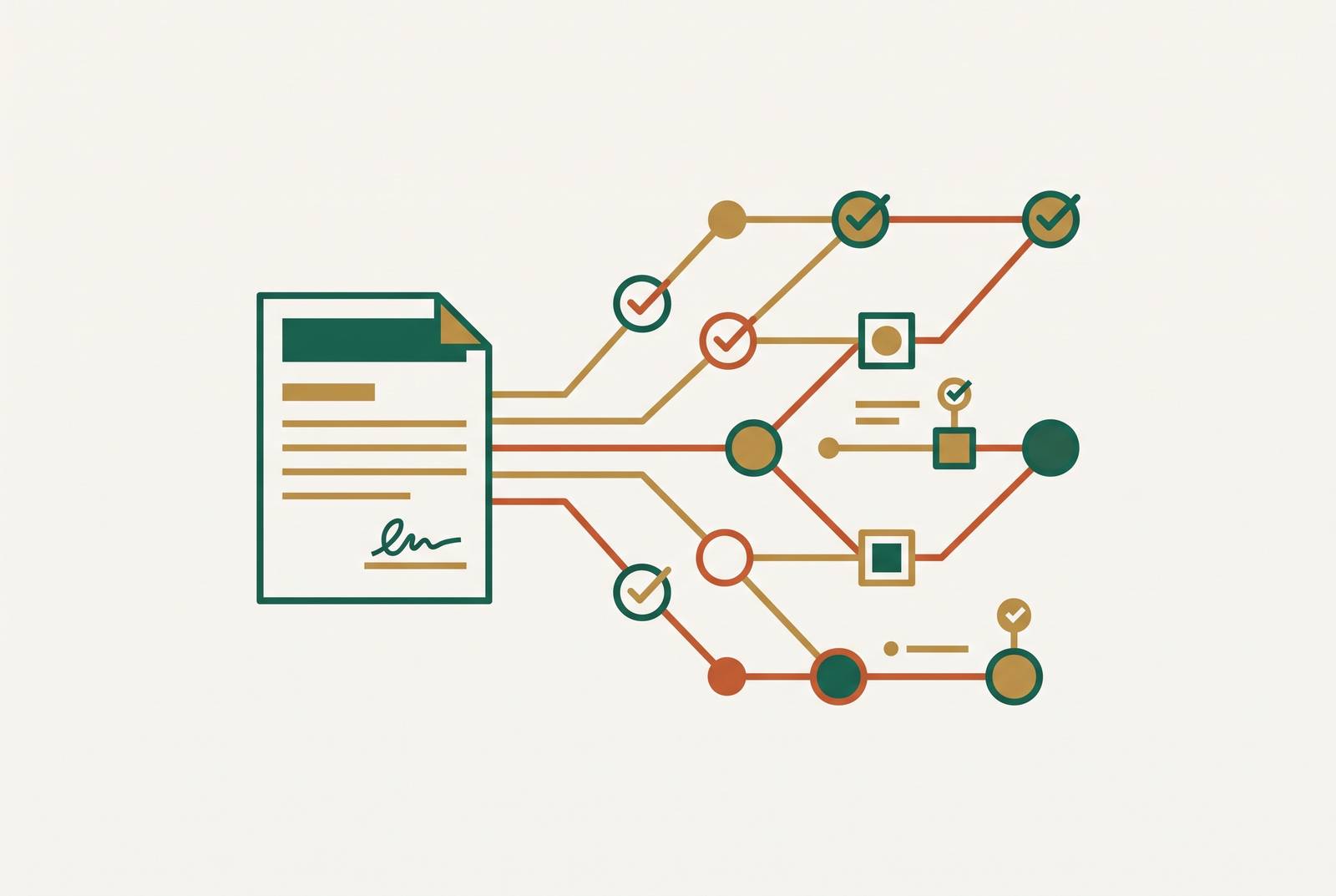
Post-signature contract management is the discipline of governing what happens after a contract gets signed, and it is where most enterprises quietly lose money. Once ink dries, obligations need owners, deadlines need tracking, and vendor performance needs watching, yet this is exactly where oversight tends to collapse.
The dominant pattern in large organizations is simple: a contract gets executed, someone saves the PDF to a shared drive, and the document effectively disappears. Payments still have to process. Renewal windows still approach. Service levels still need checking against what a vendor actually delivers. None of that stops just because nobody's watching. The World Commerce and Contracting association has found that 95% of organizations lack full visibility into their own contractual obligations, which makes the blind spot the baseline condition of doing business, not some rare failure mode.
The cost of that blind spot appears in the numbers. Research from Viewpoint Analysis's 2026 buyer guide and from Sirion both put revenue leakage tied to poor contract management at around 9% of annual revenue. That 9% doesn't vanish in one dramatic event. It bleeds out through five distinct failure modes: obligations that get missed because tracking is manual and deadlines slip past unnoticed, leadership operating without a real-time view of how the contract portfolio is actually performing, compliance controls too weak to produce audit evidence when regulators come asking, auto-renewals firing off without anyone reviewing the terms first, and legal, finance, procurement, and operations all working from separate, disconnected pictures of the same agreements.
None of that is a technology failure at its root. It's a governance failure, and a process failure, that technology happens to be well-suited to fix. The rest of this piece works through each discipline that makes up post-signature management and what actually needs to be built to keep signed contracts from turning into forgotten ones.
What post-signature contract management covers
Post-signature management is the structured, ongoing process of governing, monitoring, and enforcing contractual obligations once a contract goes into effect. That's a different job entirely from what happens before signature. Pre-signature work is about preventing risk and getting the deal closed: redlining, negotiation, approval routing. Post-signature work is about realizing the value the deal was supposed to create in the first place, and containing whatever risk remains once the parties are locked in.
Sirion's breakdown of the discipline covers obligation and milestone tracking, performance and SLA monitoring, billing and revenue alignment, compliance management, amendments and change management, renewal and termination management, and audit and reporting support. Most organizations only ever build for one or two pieces of it, usually storage and maybe a renewal calendar, and call the job done.
The reframe that matters here is a shift from "administration" to "governance." A contract sitting in a drive is administered, in the loosest sense: it's filed, it's retrievable if someone remembers to look. A contract under governance is being actively worked: its obligations are assigned, its milestones are tracked, its performance is measured against what was promised. Without that governance layer, a signed contract is a static document rather than an operating tool.
Large enterprises feel this acutely because most contract-related losses occur after execution, not before. Complexity and volume are what turn a manageable gap into a structural one. A team with 40 active contracts can survive on spreadsheets. A team with a far larger volume of contracts cannot. Some organizations have nothing more than a PDF on a drive, some have graduated to a spreadsheet acting as a system of record, and a smaller group has built genuine operational infrastructure around their contracts. This piece is aimed at the first two groups and what it takes to get to the third.
Obligation extraction: turning signed language into trackable commitments
A signed contract is dense legal language, and the obligations buried inside it stay invisible to the business until someone actually reads them out and assigns them to a person. That reading-out step is obligation extraction, and it's the foundation everything else in post-signature management sits on.
Extraction converts a clause into a structured record with a named owner, a due date, defined performance criteria, an automated reminder path, and a record of completion evidence for whenever an audit comes around. Common obligation types that need pulling out include payment commitments, renewal deadlines, audit rights, service-level agreements, procurement milestones, data privacy provisions, and various post-signature duties that don't fit neatly into any one category.
AI has changed the speed at which this extraction happens. Loio's data shows a large language model analyzing a standard NDA in 26 seconds, against 92 minutes for a lawyer doing the same review by hand, at 94% accuracy. That gap holds directionally across obligation extraction at scale: a portfolio of a few thousand contracts simply cannot get read clause-by-clause by human reviewers on any timeline that matters to the business.
Speed alone doesn't make extraction trustworthy, though. AI handles the first pass, pulling obligations and classifying them; a legal professional still needs to validate the findings, apply business context an algorithm doesn't have, and assign real ownership to a real person. Neither side of that pairing gets the job done alone. An obligation with no owner is functionally an obligation that will get missed, because nothing in the system was built to catch it. Extraction builds the inventory of what's owed. What comes next is keeping that inventory alive.
Deadline and milestone tracking: the infrastructure that keeps obligations from being forgotten
Knowing what an obligation is and knowing when it's due, and to whom, are two separate operational problems. Most manual systems collapse them into one step and end up failing at both.
The failure pattern is familiar to anyone who's worked inside a legal or procurement team running on spreadsheets: someone updates a tracker by hand, reminder emails go out to an inbox that belonged to an employee who left eight months ago, and there's no escalation path when a deadline gets blown past. That setup can limp along at low volume. It breaks the moment volume climbs.
Effective tracking needs a few things working together: centralized ownership with a named accountable party on every obligation, reminders calibrated to lead time rather than firing only on the deadline itself, escalation logic that kicks in automatically when nobody's acknowledged or completed a task, reminder delivery across multiple channels to cut down the odds of something getting missed, and integration with the calendar and workflow tools people are already using, so deadlines show up where the work actually happens instead of in a system nobody opens.
Renewal governance deserves its own mention as the highest-stakes deadline category in the whole discipline. Auto-renewals that fire without a strategic review are a recurring and expensive failure, letting a vendor relationship roll forward another year, a price lock in at last year's rate, or an unfavorable term nobody meant to keep just persist. Tracking a renewal properly means more than a calendar alert on the date. It means a review workflow: who assesses the relationship, who makes the call to renew or renegotiate, and how much lead time that decision actually needs. Viewpoint Analysis's 2026 buyer guide notes that AI-driven forecasting can now flag renewal risk before it turns into revenue risk, giving teams the runway they need instead of a same-day scramble.
Zoho's State of Contract Management survey found compliance is the leading concern for 43% of legal professionals, and deadline failure is a big part of the mechanism behind that number. It doesn't help that approval delays have been reported to average around 3.4 weeks across industries. When a tracking system doesn't surface an obligation early enough, that lag alone can eat up the entire window an organization had to respond.
Performance monitoring: connecting contractual commitments to what counterparties deliver
Obligation tracking makes sure an organization meets its own commitments. Performance monitoring makes sure the counterparty meets theirs. Without it, contract management turns reactive by default, disputes only surface once a failure is too obvious to ignore, and by then remediation costs far more than catching the problem early would have.
In practice, Sirion holds that performance monitoring means tracking service-level metrics and KPIs against the thresholds written into the contract, watching response times and availability and quality standards, spotting recurring gaps that signal a structural pattern of underdelivery rather than a one-off slip, and checking whether penalty, credit, or remediation rights actually get enforced when a vendor falls short.
There's a financial dimension here too that often gets treated as purely a finance department's job. Contract terms directly govern billing accuracy and revenue recognition, so checking invoices against the pricing the contract specifies is a performance monitoring function as much as a finance one.
LinkSquares's 2026 guide frames this well: ERP and CRM systems tell a business what's happening right now, while contract obligation software tells the business what's supposed to happen. Those two pictures have to sync up, or neither one is worth much on its own. That means performance monitoring can't stay inside legal. It needs data flowing from operations, finance, and procurement, and if the contract platform doesn't connect to those systems, the monitoring stays theoretical instead of operational. The upside of doing it right is a continuous performance record, which becomes the audit trail regulated industries need and that any organization wants on hand the moment a dispute lands.
The centralized repository: why storage and intelligence are two different problems
Most organizations have a place where contracts live. Very few have a system that makes those contracts searchable, reportable, and actually wired into the rest of the business. That gap between storage and intelligence is the central architectural problem in post-signature management.
A shared drive gives a location and nothing more. Contracts sitting there as static PDFs can't be searched at the clause level, can't surface an obligation on their own, and can't alert anyone to an approaching deadline. Every update means a manual re-upload, and there's usually no real audit trail of who changed what and when, or it's kept by hand and gets stale fast.
A purpose-built repository, as described by both Juro and Sirion, works differently. It offers secure centralized storage with access controls set at a granular level, OCR and AI-powered search across the entire contract estate, version control with a complete record of every change and approval, a single always-current version so nobody's stuck asking which copy is the final one, and filtering by status, owner, counterparty, contract type, or expiration date.
Icertis's approach, described in Viewpoint Analysis's buyer guide, structures every agreement into searchable, reportable metadata from the moment it's executed, which turns the repository into a live dataset instead of a filing cabinet. That distinction matters most in regulated industries, where a complete, searchable trail of every obligation, approval, and action is the evidence base a regulator expects to see. It's the evidence base a regulator expects to see, and without it, compliance is just a claim the organization is making about itself rather than something it can actually demonstrate. None of that works, though, if the repository sits isolated from CRM, ERP, finance, and procurement systems. The same logic applies to integration: obligation data has to flow into the systems where the work actually gets done, or the repository stays an island nobody outside legal ever visits.
How AI changes the scale equation for post-signature management
Enterprises routinely manage hundreds or thousands of active contracts at once, and manual extraction, tracking, and monitoring simply doesn't hold up at that volume. Something has to give, and increasingly, that something is the manual part of the process.
Adoption numbers back up how fast this shift is happening. A survey from ACC and Everlaw found corporate legal AI adoption more than doubled in a single year, climbing from 23% in 2024 to 54% in 2025. Icertis's research puts the figure using AI specifically for contracting workflows at 44%, with redlining, review, and summarization leading the way.
In the post-signature context, AI is doing clause-level extraction and obligation identification from executed agreements at a speed manual review can't touch, monitoring renewal and termination windows with automated alerts, scoring risk and flagging exposure across an entire portfolio, forecasting renewal risk before it turns into a revenue problem, running natural-language search across the full contract estate, and generating obligation summaries plain enough for stakeholders outside the legal department to actually use.
None of that is a reason to skip governance. DISCO's research makes clear that organizations are increasingly being held accountable for how they deploy these tools. That same survey found 86% of law firms and corporate legal departments plan to fold generative AI into routine legal work within the next two years, but the ones without a governance framework already in place are going to find that transition considerably harder than the ones who built one first.
Security isn't a feature to negotiate on here. AI systems handling executed contracts are touching an organization's most sensitive commercial commitments, and enterprise-grade security along with strict data governance are baseline requirements, not upgrades. Training a vendor's AI model on a customer's contract data is a line that should never get crossed. And the human-AI split still matters just as much here as it did in extraction: AI does the heavy lifting on scale, monitoring, and flagging, while legal professionals validate the output, bring business context, and make the calls that actually count.
Implementation doesn't always go smoothly. More than 40% of AI rollouts stall out after the initial pilot phase, usually from poor planning, thin training, or an attempt to automate too many processes all at once. Post-signature AI adoption needs a deliberate sequence.
What enterprise-grade obligation tracking software should do
Evaluating a CLM platform for post-signature work means looking past repository features and asking how well the platform actually operationalizes obligations, not just stores them. LinkSquares's 2026 guide lays out roughly what that checklist should include going into next year.
The core requirements: automated obligation extraction pulled straight from executed agreements, not just metadata tags slapped on after the fact; triggered reminders with lead times a team can actually configure and escalation paths that fire when needed; renewal and termination monitoring backed by AI forecasting rather than a static calendar; real-time surfacing of compliance risk; workflow orchestration that routes obligations to the right owner in the right system, across functions; an audit history solid enough to hold up under regulatory review; and integrations with ERP, CRM, and finance systems so obligation data actually reaches the people responsible for acting on it.
Viewpoint Analysis's 2026 buyer guide evaluated a set of platforms at the enterprise tier. Icertis Contract Intelligence builds around a contract data model that turns every agreement into searchable, reportable metadata from the point of execution, with a customer base spanning global manufacturing, healthcare and life sciences, financial services, technology, media and telecom, the public sector, and retail and consumer goods. DocuSign CLM and Workday Contract Intelligence, the platform built on Evisort's technology, were also evaluated at the enterprise tier.
At the mid-market tier, the same guide evaluated Ironclad, Gatekeeper, and Concord. Where an organization lands on this list depends less on brand recognition than on how far along that storage-to-intelligence spectrum it actually needs to move, and how much of its contract volume can still tolerate a human reading every clause by hand before that stops being realistic.
