AI-Assisted Contract Abstraction for Legacy Contract Portfolios
AI can extract contract data at scale, but legacy portfolios need AI-specific terms mapped first.
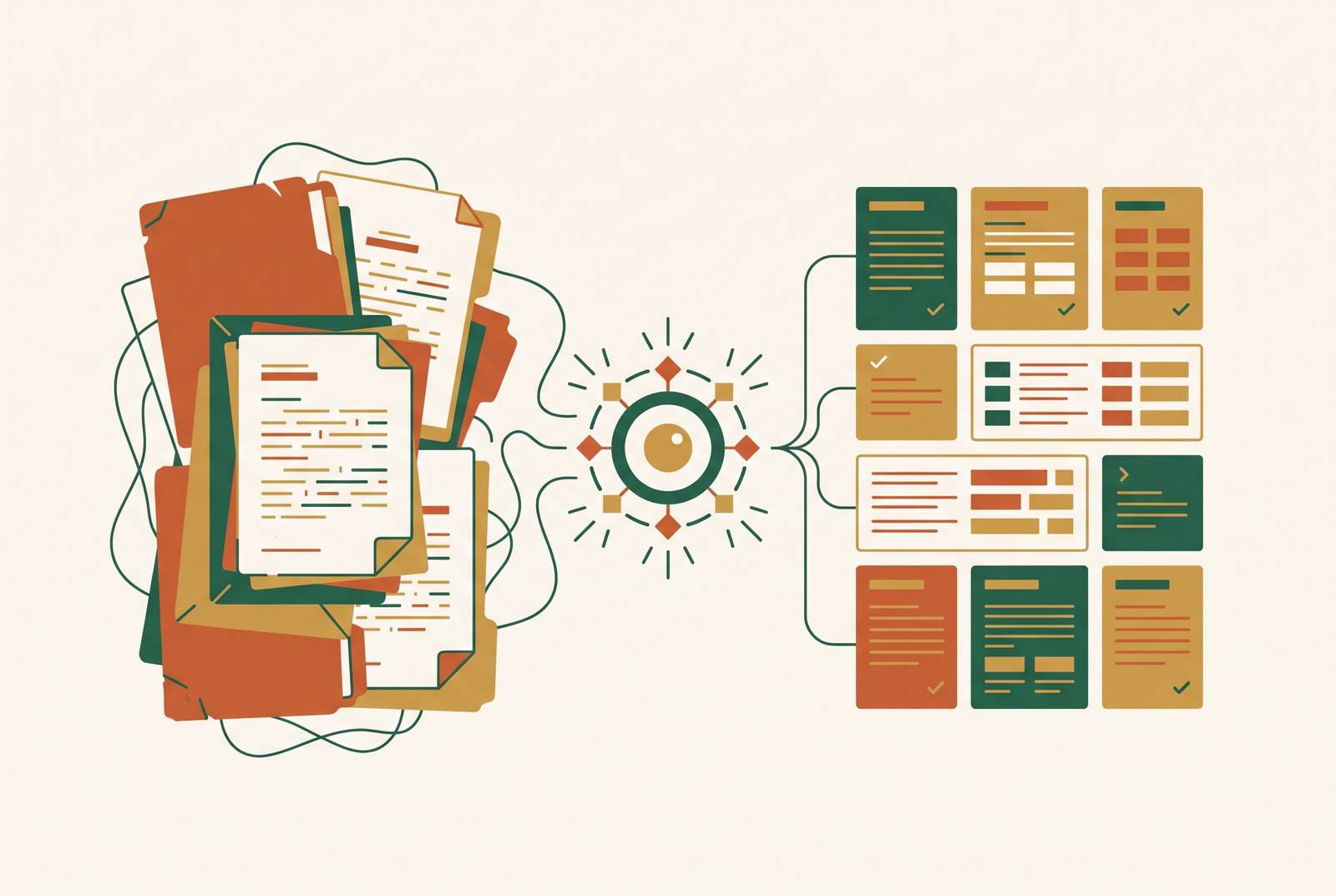
Picture a legal team that has spent a year building a thorough internal AI governance policy, covering employee tool use, approved models, and data handling rules, and has never once checked what its existing vendor contracts already permit. That asymmetry is the actual risk. Legacy contract portfolios build up over many years. Most were negotiated before generative AI became a concern, so they have no AI-specific provisions. Silence in a contract is a legal position, set by default, and it may not reflect what the organization would choose if it were negotiating that clause today. The exposure here does not come from what employees do with AI tools on their own devices. It comes from what counterparties are already permitted to do under agreements that were signed years before anyone was thinking about model training or algorithmic decision-making. Vendor contracts have not kept pace with how AI models actually work or how the parties should allocate the risk from their use, so a vendor may hold broad rights to process, analyze, or even train on an organization's data, and nobody on the legal team may realize that permission exists. A portfolio with thousands of agreements cannot be read clause by clause at the pace of a normal legal team's workload. So the gap between what the organization's current policy wants and what its signed contracts actually allow can persist indefinitely, because nobody has the practical means to find it.
What contract abstraction actually does, and how it differs from summarization and review
Contract abstraction is a structured data extraction exercise. It is not legal analysis, and it is not a narrative summary, and treating it as either one leads to misaligned expectations, the wrong tooling choices, and wasted project effort. Consider a legal ops team abstracting a single vendor agreement: the output includes the counterparty name, contract value, payment terms, auto-renewal clause, termination notice period, liability cap, and governing law, organized into a standardized data card that can be searched, compared, and reported on in seconds. That is abstraction. Contract review is a different discipline entirely: it assesses legal quality and risk, produces redlines and risk flags, and depends on human legal judgment for complex terms, which makes it only partially automatable no matter how capable the underlying AI gets. Contract summarization is a third activity: it produces a plain-language narrative that helps an executive get the gist of an agreement, but it offers no structured record built for database storage or system integration. AI contract abstraction specifically targets the structured data extraction problem: payment terms, renewal dates, termination rights, liability caps, governing law, and obligation milestones, all captured as fields that can live in a CLM, get queried across an entire portfolio, and feed directly into ERP, CRM, or billing systems. The operational distinction matters because you can automate abstraction almost entirely, but review stays only partially automatable. Teams that blur the two either lean on AI to make judgment calls it should not be making, or they fail to use it for the extraction work it already handles reliably.
How AI-Assisted Abstraction Works, From Ingestion to Structured Output
The abstraction pipeline runs through four distinct stages, and each carries its own failure modes, which is what separates a realistic implementation plan from the expectations set by a vendor demo. The first stage is ingestion and OCR: the system accepts contracts in whatever format they arrive in, PDF, Word, or scanned image, and for scanned documents, optical character recognition converts the image into machine-readable text, making even decades-old paper contracts processable. OCR quality on poor scans or handwritten annotations is a well-documented source of downstream extraction error, so you need to pay attention to it from the start. The second stage is extraction itself, where the system pulls the target fields out of the now-readable text. Standard fields, parties, effective dates, pricing and payment terms, renewal and termination clauses, notice periods, liability caps, governing law, get identified with high reliability because the platforms have been trained on large volumes of commercial agreements that use fairly consistent language for these provisions. The third stage is validation, built around a human-in-the-loop process, and it verifies complex or low-confidence data. Platforms surface a confidence score for each extracted field, so a reviewer's attention goes to the fields where the system itself is uncertain rather than requiring a full re-check of every output. The fourth stage is integration: the structured data flows directly into CLM, ERP, CRM, or billing systems, connecting legal language to the financial workflows that depend on it, revenue recognition, obligation tracking, renewal calendars, without anyone re-keying the same data by hand. OCR quality on legacy scanned paper is a well-budgeted planning input for most abstraction projects, not a late-stage surprise.
The Data Extraction Target List
Defining the extraction template before any document gets processed is the single most consequential decision in a legacy abstraction project, because the fields you choose at the outset determine what questions the portfolio can answer once the work is done. A core template belongs in virtually every commercial contract abstraction project, and it should capture the parties involved, their roles, and the effective dates of the agreement, along with contract value, pricing structure, and billing frequency. It should capture payment terms and conditions, auto-renewal clauses and the notice periods required to stop them, termination rights and exit conditions, liability caps and indemnification provisions, governing law and the dispute resolution mechanism, and the key performance obligations and delivery milestones that define what each party owes the other. For a legacy portfolio specifically, the template needs a second layer built around AI governance. This is where the exercise connects directly back to the exposure described at the start: whether the agreement permits the counterparty to use AI for data processing, summarization, or decision-making; whether it permits the vendor to train AI models on the organization's data; what human oversight requirements, if any, apply to AI-generated outputs that affect performance or deliverables; whether audit rights extend to algorithmic decision logs; and which risk tier the vendor's AI use falls into, whether that is administrative automation, AI-assisted analysis, or AI-determined outcomes. A template built this way turns a pile of documents into a system that can answer concrete portfolio-level questions, such as which vendor contracts auto-renew in a given quarter or which agreements permit a vendor to use the organization's data for model training, questions that would otherwise require reading hundreds of individual files. Abstraction also solves a structural problem most teams overlook going in: portfolios accumulate amendments and renewals that sit in isolation from the agreements they modify, and AI can connect the master agreement, each amendment, and the renewal into one aligned record without manual tagging. You should not leave any of this to a platform's default field list. The template belongs to legal ops, built in collaboration with finance, procurement, and the business units that will actually use the resulting data, because those are the people who know which questions the portfolio needs to answer.
Why the migration workstream is where legacy abstraction projects actually succeed or fail
For most organizations working through a legacy portfolio, assembling a clean, consolidated repository of the contracts themselves is the project, and it typically costs more and takes longer than the software license that comes after it. Every abstraction platform works from a repository of documents, and if the executed agreements are scattered across shared drives, individual email inboxes, and physical filing cabinets, building that repository is the majority of the work, not a preliminary step tucked in before the real work starts. OCR processing of scanned legacy paper deserves its own dedicated workstream, with its own cost and its own quality control, because poor scan quality is the leading cause of extraction errors further down the pipeline, and it needs to be budgeted and scheduled separately from whatever the platform costs. None of this means migration has to stop a project from moving forward. Teams that plan for it finish on schedule, and teams that do not plan for it discover the scope of it somewhere in the middle of implementation, at the point where it is most expensive to absorb. The practical move before selecting a platform or setting a project timeline is a document inventory: count the agreements by format, digital-native versus scanned, by location, centralized versus distributed across departments and drives, and by completeness, master agreements with all their amendments attached versus standalone files missing context. That inventory is what turns migration from a guess into a plan.
Where Human Judgment Remains Load-Bearing in AI-Assisted Abstraction
AI abstraction performs reliably on standard clause types at scale, and the honest reason to trust it on those fields is that the accuracy ceiling drops on exactly the provisions that carry the most legal and financial risk: non-standard clauses, complex cross-references, and bespoke negotiated terms. Platforms trained on large volumes of commercial agreements can identify renewal dates, termination rights, payment terms, and liability caps with high accuracy. That accuracy declines on clauses that deviate from market-standard language, on provisions that depend on multiple cross-referenced exhibits, and on terms built around complex conditional logic, and the most common errors reported across abstraction platforms cluster in exactly these categories: non-standard clauses, complex rent or fee escalation formulas, and terms buried in cross-referenced exhibits and amendments. Confidence scoring is what makes human review efficient instead of exhaustive. Reviewers can focus on the low-confidence extractions the system flags, so the process stays fast without giving up accuracy where it counts. Humans still decide whether an extracted term is acceptable for the business, how a non-standard clause should be classified or tagged, and whether a flagged provision needs renegotiation, escalation, or a formal governance response. AI identifies the issue; a person decides what to do about it. This division applies with particular force to the AI-governance fields described earlier: the system can flag a contract where a vendor holds broad data processing permissions, but only a human reviewer can judge whether those permissions create unacceptable risk against the organization's current AI governance policy, and only a human can choose the remediation path from there. Teams that configure the workflow to let AI make final acceptability calls run into trouble. Teams that build the workflow so AI handles volume and people handle judgment get reliable results at scale, and that division of labor, not a contest between the two, is the actual design principle: route high-confidence standard-field extractions to auto-approval, route low-confidence fields and every non-standard clause to a human review queue, and never skip that review tier for a provision carrying financial, regulatory, or reputational weight.
Sequencing a Legacy Abstraction Project From Document Audit to Portfolio Intelligence
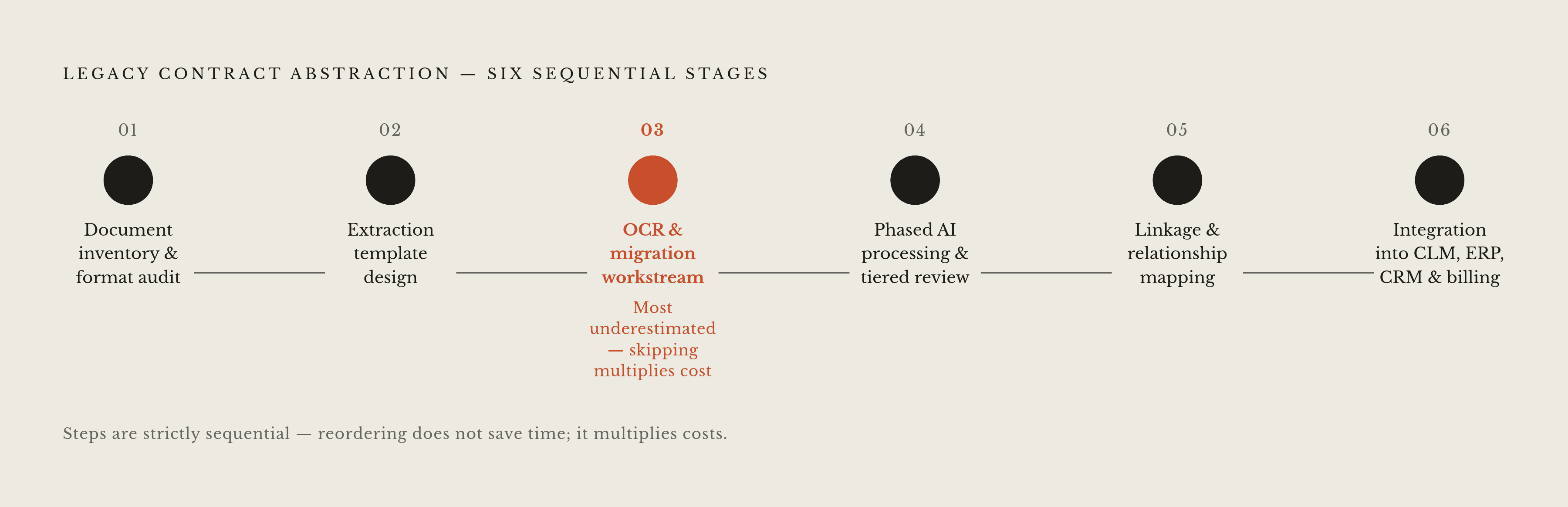
A legacy abstraction project that follows its steps in order, document audit, extraction template design, migration and OCR, phased AI processing with human review, and CLM integration, closes the governance gap described at the start of this piece on a predictable timeline. Skipping steps or reordering them does not save time. It multiplies the cost of whichever step you skipped once the project reaches it anyway. The first step is a document inventory and format audit: count every executed agreement by format, digital-native or scanned, by location, and by structural completeness, and surface every amendment, side letter, and order form and map it to its parent agreement. This inventory sets the OCR scope, the migration timeline, and the platform requirements before you even talk to a vendor. The second step is extraction template design, built in collaboration with legal, finance, and procurement around the specific questions the organization needs answered, renewal exposure, auto-renewal dates, AI-permission clauses, liability caps, termination triggers, rather than inherited wholesale from whatever field list a platform ships with by default. The third step is the OCR and migration workstream itself: scanned documents go through OCR as a dedicated pre-processing stage, a sample of that output gets quality-checked before anything moves to the abstraction engine, and the whole workstream gets its own budget line and its own timeline rather than getting treated as a feature bundled into the platform subscription. The fourth step is phased AI processing with confidence-tiered review: you work through the portfolio in batches, configure confidence thresholds so high-confidence standard extractions move to auto-approval while low-confidence fields and non-standard clauses route to human review queues, and start with the contracts carrying the highest risk exposure or the nearest renewal dates. The fifth step is linkage and relationship mapping: you connect amendments, renewals, and order forms to their master agreements inside the CLM so each counterparty relationship exists as one complete structured record. The sixth and final step is integration and portfolio activation, where the structured output feeds into the downstream systems, CLM, ERP, CRM, and billing, that depend on it, turning a portfolio that once required manual reading into one that can answer a question the moment someone asks it.