Piloting AI Tools in Legal Without Disrupting Active Deal Flow
Test AI on low-risk contracts before trusting it on major deals.

Legal departments have moved past the experimentation phase with AI, and that shift changes what a "pilot" actually risks. FTI Consulting and Relativity's General Counsel Report found that a large majority of general counsel now report using AI within their teams, up sharply from the prior year, so the competitive cost of delayed or botched adoption is real. That kind of adoption curve carries a cost for whoever moves slowly or moves sloppily, because the rest of the market isn't waiting.
This surge in adoption is driven by real workload pressure, not idle curiosity about new software. CLOC's State of the Industry Report found that workload and bandwidth top the list of challenges for most legal departments, and an even larger share expect that demand to keep climbing. Legal teams don't have room for a pilot that grinds deal flow to a halt while everyone figures out the interface.
The visibility has changed too. According to Legartis's analysis, the CFO is now asking why AI isn't already in production. That question turns what used to be a legal ops side project into a board-level agenda item, and it means a fumbled rollout doesn't stay contained to the legal department. It gets noticed upstream.
None of this means teams should rush. It means the old approach, an unstructured pilot with a few enthusiastic volunteers testing a tool on whatever crosses their desk, no longer carries low stakes. After Tier 1 (high-volume, low-risk, standard form, queued review) is validated, expansion moves to Tier 2: moderate-complexity agreements still in the pre-negotiation stage, where the team can apply AI review before the counterparty exchange begins. Moving fast and moving carelessly are not the same instruction, and the rest of this piece is about how to do the first without doing the second.
Why active deal flow is vulnerable to a pilot
Contract review sits at the center of this risk because it's where an AI mistake turns into a business consequence with no undo button. A missed clause or a misapplied playbook on a live negotiation doesn't get a second draft once the counterparty has signed. Other legal AI use cases, research memos, internal summaries, first-pass document tagging, tolerate an error because someone reviews the output before it touches the outside world. A live deal doesn't offer that cushion in the same way.
The liability exposure isn't theoretical. By late 2025, researchers had tracked more than 120 court cases worldwide involving AI hallucinations, and courts have held counsel responsible for those errors regardless of which department chose the tool. That detail matters for legal ops teams that assume the burden lands on whoever picked the vendor. The burden doesn't land on whoever picked the vendor; the lawyer signing off on the work carries it.
Transparency gaps make the exposure worse before anyone notices it. Everlaw's Chief Legal Officer, Gloria Lee, has pointed out that most in-house teams don't actually know whether their outside firms use generative AI on their matters. Apply that same blind spot internally, where nobody tracks which deals ran through an AI-assisted review and which didn't, and an error can sit undetected for weeks rather than getting caught at the first checkpoint.
Not every contract carries the same downside. A missed auto-renewal clause on a vendor agreement is an annoyance: someone catches it, negotiates an exit, moves on. A misread indemnity cap buried in an M&A ancillary document is a different category of problem entirely, one that can reshape who bears risk on a transaction worth far more than the contract itself. A sequencing strategy is built to exploit that gap between recoverable and irreversible.
Sequencing the pilot: what to review first
The entry point that works is high-volume, low-risk, third-party paper: contracts where an AI error costs little to fix and where there's enough volume flowing through to generate a real read on performance within weeks rather than months. One is disposable if the tool stumbles. The other is not.
Standard form agreements, NDAs, vendor MSAs, routine statements of work, make good starting material because the legal team already has a stable playbook to test the tool against. These are also, by design, contracts coming in from third parties for review rather than documents drafted from a blank page. A human checks the AI's output before anything gets signed instead of trusting it to originate language unsupervised.
Harvey's October 2025 framework finds that the most effective pilots start with a defined time period, targeted use cases, and a cross-functional group instead of a full team rollout on all contract types at once. HubSpot's legal operations team followed that exact sequence, picking a cross-functional group, folding the tool into existing workflows, and measuring efficiency gains before expanding further; day-to-day tasks got done faster, which freed up lawyers for the deeper analytical work a machine can't do.
The choice of use case matters as much as the choice of contract type. Checkbox's 2026 comparison of legal AI tools found that intake, document automation, and knowledge management deliver the fastest return on investment, ahead of contract review itself. Contract review against a standard playbook still earns its place as the strongest starting point for teams buried in high volumes of similar third-party paper, but it won't be the fastest win on the board. Pick the volume tier where demand runs highest and individual stakes run lowest. That's where the tool learns the team's playbook and the team learns where the tool breaks, without betting a material transaction on the outcome.
What to quarantine from the pilot
Choosing where to start only solves half the problem. A pilot also needs an explicit list of what stays untouched, because teams that define an entry point without defining a boundary tend to drift into higher-stakes territory the moment the tool looks like it's working.
Some deal types belong off-limits from day one. Anything currently in active negotiation with a counterparty should stay off the tool, since the playbook hasn't been validated yet and redline errors compound in real time once both sides are exchanging drafts. Material commercial agreements carrying significant indemnity provisions, liability caps, or IP ownership exposure belong in the same category. So does any contract where outside counsel is co-reviewing the work: mixing AI-assisted review with external counsel review, without disclosing it, recreates the exact transparency gap Gloria Lee flagged, just moved inside the building instead of outside it.
Certain moments in the workflow deserve the same treatment regardless of contract type. Final review before signature is one of them: AI shouldn't function as the last set of eyes on a live deal during a pilot period, no matter how well it performed on the queue that got it there. Drafting a response to a counterparty's redline on a contentious point is another, since that kind of judgment call hasn't been proven out in the team's specific environment yet.
None of this reflects distrust of the tool. Using public AI tools for client work without a human checking the output has become a clear ethical violation, and the quarantine list functions as the practical version of that human-in-the-loop requirement while the tool is still earning trust. Treated this way, quarantine is the discipline that lets a team expand with confidence later, because everyone already knows what stayed protected while the tool proved itself.
Structuring a pilot that produces a real decision
Most legal AI pilots never produce a clean go or no-go answer, and the reason is straightforward: nobody designed them to produce one. It's generated activity. Fixing that means settling three questions before the pilot ever launches: what performance threshold justifies expanding the tool, what threshold justifies walking away from it, and who holds the authority to make either call, and at what point in the timeline.
Someone inside the organization has to own this operationally, and it can't be the vendor's customer success manager. Without an internal legal ops owner handling setup, answering questions during the first few weeks, and keeping the underlying playbooks and clause libraries current, usage drops off and the tool gets quietly abandoned within months.
A handful of design choices separate a pilot that generates real signal from one that generates noise. Build the pilot group across individual contributors, managers, and leaders rather than just the most enthusiastic early adopters, so the results reflect how the tool performs across different roles and not just how it performs for people who were already sold on it. Run structured training with guided sessions and office hours instead of a self-serve rollout, since the latter tends to produce inconsistent usage that's hard to read afterward. Collect feedback and usage recaps on a regular cadence throughout, not just at the end, so reviewers can identify power users and struggling users in the data while there's still time to adjust.
Close the pilot with a tailored ROI analysis that measures time saved in concrete terms, since that number is the clearest lever for making the expansion case and the most persuasive evidence to bring to anyone above legal ops. That's the scale of signal a well-built pilot should be looking for.
If the results come back unclear, resist the urge to file it under "the tool didn't work." Separate a tool problem from an adoption problem from a use-case selection problem, because each one has a different fix, and treating them as the same thing leads either to abandoning a tool that would have worked with better rollout, or doubling down on a deployment that was broken from the start. Tools embedded directly into the platforms lawyers already use, Outlook, Word, SharePoint, existing document management systems, tend to see higher adoption than standalone tools that force lawyers to switch context every time they need them.
Expanding the pilot without reopening the deal-flow risk
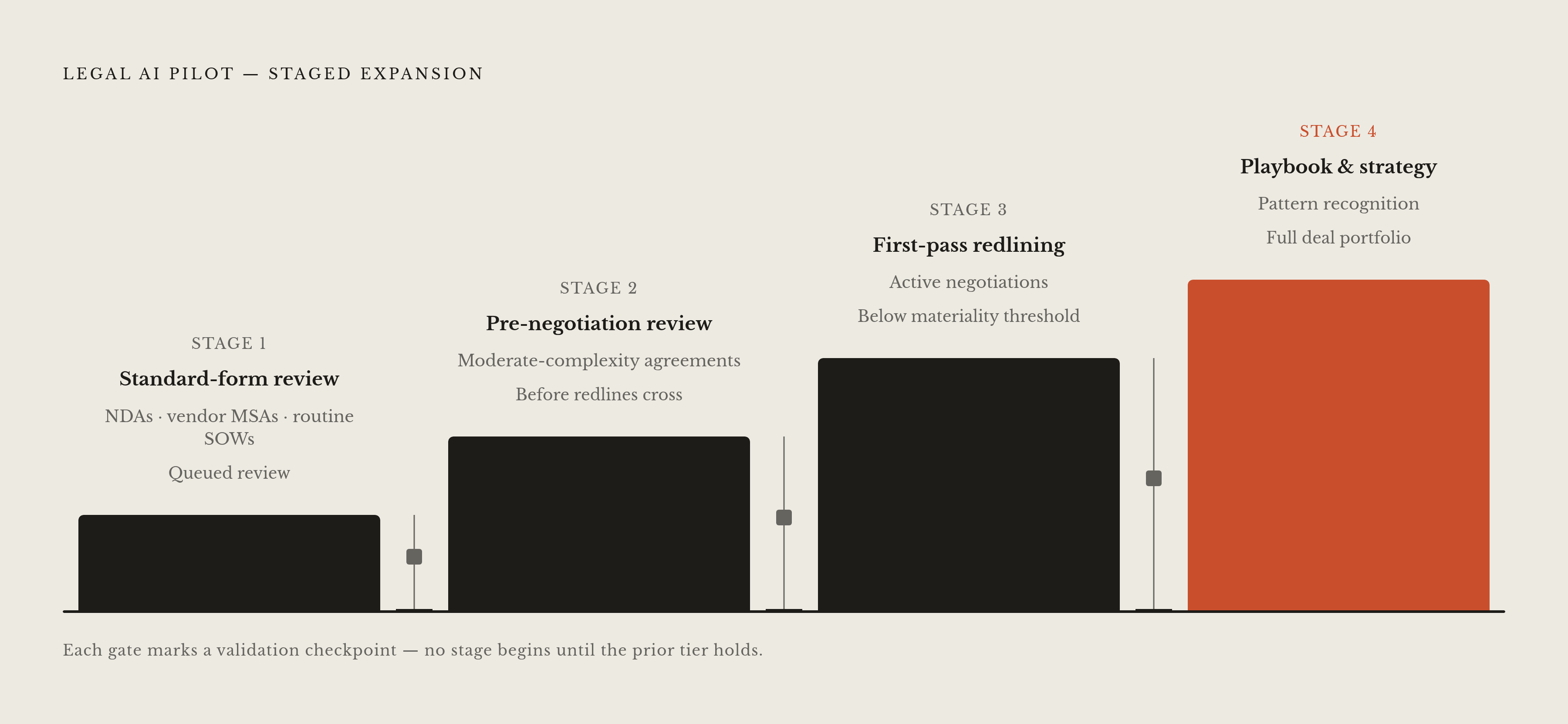
Expansion should follow validated performance rather than a calendar. New contract types and new workflow moments get added only once the prior tier has proven itself, and skipping that sequence for the sake of a quarterly timeline is how teams end up reintroducing the exact risk the pilot was built to avoid.
The path runs in stages. After the first tier, high-volume, low-risk, standard-form contracts under queued review, has been validated, expand to moderate-complexity agreements still sitting in the pre-negotiation stage, where AI review can run before any redlines cross the table with a counterparty. Once that tier holds up, introduce AI-assisted first-pass redlining on agreements that are in active negotiation but fall below the materiality threshold set out in the quarantine list. Once that tier holds up too, the tool becomes a reasonable candidate for playbook development and negotiation strategy work, where its pattern recognition across a portfolio of prior deals can inform how the next one gets approached.
That last stage is where the framework starts to pay for itself in a different currency. Every negotiation a legal team runs contains intelligence that should carry forward into the next one, and a validated tool can hold onto that institutional knowledge across a whole portfolio of deals instead of losing it the moment each one closes. The agentic horizon that expansion builds toward includes zero-touch contracting for low-risk agreements and AI-generated negotiation playbooks, but these capabilities are only safely accessible to teams that have already validated the tool on lower-stakes work and built the governance layer to supervise autonomous action.
Each stage of expansion needs its own governance checkpoint attached to it. Document human-in-the-loop requirements explicitly for every new contract tier the tool touches. Update the acceptable use policy to spell out which contract types are AI-assisted and to what degree, since that record is what protects a lawyer if an error on a given matter gets challenged later. Gartner projects that a large majority of organizations will have formalized AI policies covering ethical, brand, and PII risk by 2026, and each expansion decision is a natural moment to trigger that update rather than waiting for an annual policy cycle to catch up. Handled this way, the teams that sequence expansion correctly end up somewhere specific: contracts stop being just a backlog to clear and start functioning as a source of intelligence about how the business negotiates, which is the shift from reactive reviewer to strategic partner that the whole framework is built to reach.
The governance layer that makes the sequencing framework durable
A sequenced pilot without a governance layer will still produce early wins, and those wins will decay. Adoption drops off, playbooks go stale, and the tool slides back into side-project status without the institutional scaffolding that keeps AI use systematic instead of incidental.
A large majority of legal professionals already use AI in some form, but only roughly a third feel prepared when it comes to information security and governance around that use, a gap most teams are living with right now rather than a hypothetical risk. Most teams expanding their AI footprint right now are doing it without the oversight structure needed to sustain it past the pilot stage.
The three decisions that must be made before the pilot begins are these, the foundational governance requirements a research brief identifies for any expansion beyond the pilot tier. A designated internal owner, not the vendor, needs responsibility for tool configuration, user questions, and keeping playbooks and clause libraries current. A firm-wide acceptable use policy needs to explicitly prohibit inputting confidential contract data into non-enterprise AI models, and that policy needs updating every time a new contract tier gets added to the tool's scope. And a documented human-in-the-loop protocol needs to exist for each workflow the tool touches, so that if an error does happen, the team can show that proper supervision was in place at the time.
Tool selection has to treat security as a hard constraint. Large language models can retain and reveal sensitive information when prompted in specific patterns, and employees routinely paste confidential business information into AI prompts without thinking twice about where it goes. Enterprise-grade legal AI has to run under strict data privacy guarantees, and training a model on a customer's own contract data is a line that should never get crossed. Legal ops teams that build this governance layer into the pilot from the start, rather than bolting it on after the tool has already scaled, are the ones that reach the strategic partner position everyone in legal ops wants to reach, without the compliance crisis that eventually catches up with the teams that moved fast and skipped the structure.
Sources
- Best AI Tools for In-House Legal Teams (2026)
- Ten AI Predictions for 2026: What Leading Analysts Say Legal Teams Should Expect
- How AI is Revolutionizing Legal in 2026 | Legartis
- AI for In-House Legal Teams: A Practical Guide for General Counsel (2026) Swiftwater & Company
- What legal professionals say about the role of AI and law in 2026