Contract Intake and Triage Workflow Design for Legal Teams
A deliberate intake framework that routes contracts by risk and urgency outperforms informal triage.
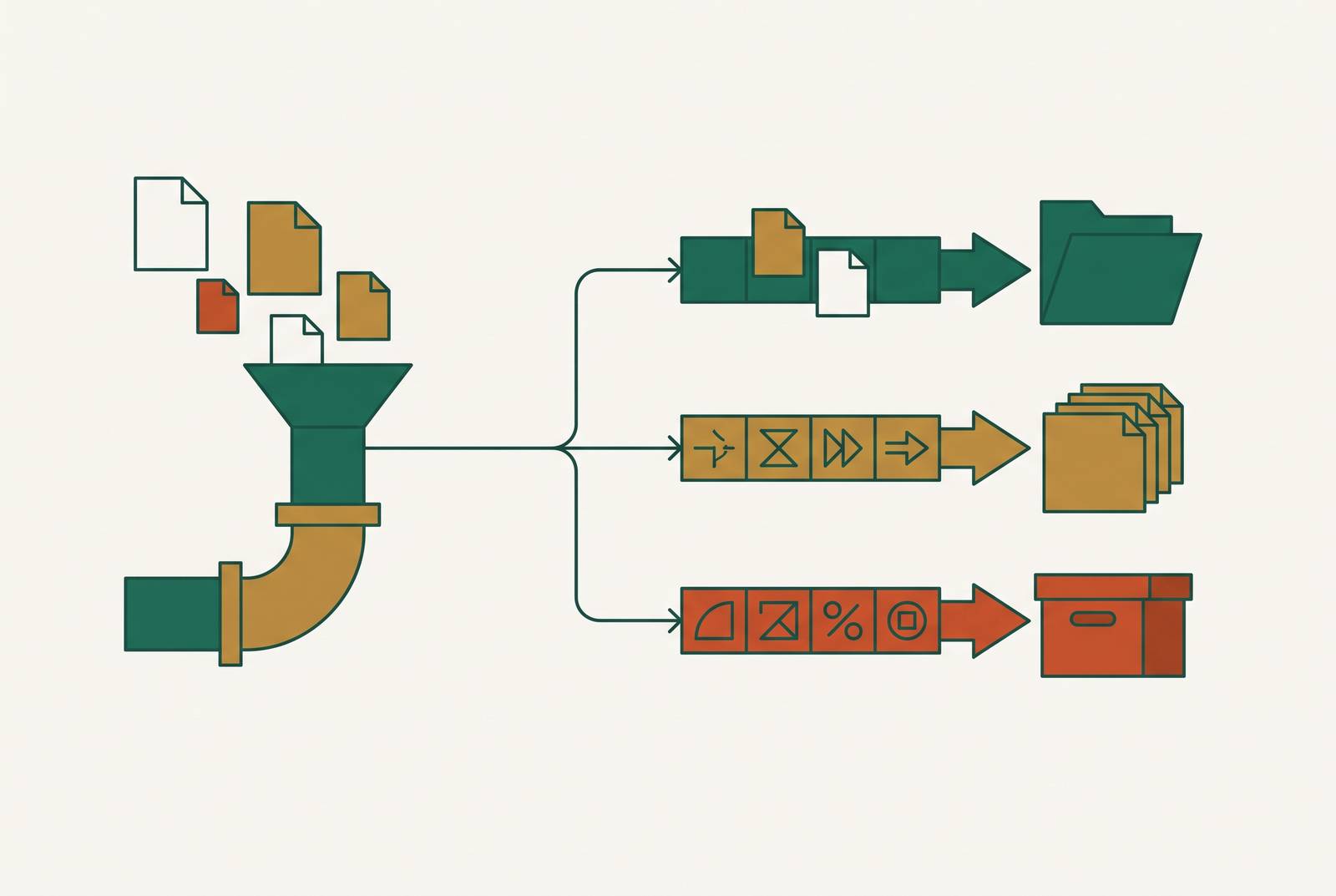
Contract intake and triage workflow design is a demand management challenge. An effective system classifies work by urgency, complexity, and risk so legal attention goes where it belongs. That requires a deliberate sequence of decisions about classification, intake, routing, and measurement before software can make the process more efficient.
Why "send an email to legal" is a demand management failure, not a process gap
An overloaded inbox, a hallway ask, and a calendar invite with no document attached all present the same problem. They ask legal to decide what matters without a common basis for comparison. A routine NDA renewal can wait behind a complex vendor negotiation while a sales rep waits for a standard service agreement. When every request competes on equal footing, the loudest internal voice can displace the highest-stakes matter.
In-house intake is structurally different from law-firm intake because it must decide what legal works on now, what queues, and what the business can self-serve. Informal triage leaves those decisions in a lawyer’s head, one email at a time, and does not scale. Kerrie Forbes, Chief Legal Officer at JSX, describes learning to triage and prioritize as a skill that can also be designed into a system. Buying software before making those design decisions pays to organize the queue without changing what governs it.
What a two-week audit reveals about where legal time actually goes
Audit incoming requests over two weeks to ground tier design in observed demand. One week is insufficient because month-end closings, quarterly cycles, and deal timing affect volume. Two weeks provides a more representative distribution from which to judge the mix of work. That distribution is the basis for thresholds.
The audit should distinguish the number of requests from the legal time they consume. Routine and repetitive work may account for a significant majority of requests, while a small number of complex matters absorb a disproportionate share of attention.
The same exercise must account for work that the visible queue conceals. Agreements that reach legal only after signature expose bypasses, while requests with too little context reveal how much work precedes classification. A follow-up conversation needed merely to understand a request is part of the intake burden.
How to build a three-tier classification framework that routes by consequence, not volume
Use the audit findings to build three tiers with rules that leave no room for guesswork. Score each request on risk based on legal and financial exposure if it goes wrong, urgency based on the real event behind the deadline, and complexity based on deviation from standard templates and approved terms. The date on a request alone does not show how urgent it is. A reviewer’s sense that an agreement feels difficult also does not show how complex it is. Contract value cutoffs must come from the organization’s own audit data and risk profile.
The green tier is a controlled self-service path for low-risk work within approved boundaries. Its guardrails are approved templates, conditional logic in the form, and periodic audit. Marvell Technology’s legal operations team built self-serve workflows that can be generated, completed, and DocuSigned in a fraction of the time previously required for work that once took hours. This makes the practical distinction clear.
The yellow tier covers work that requires the appropriate reviewer’s attention, with deviations from approved terms highlighted for review. The red tier sends higher-stakes matters to a senior lawyer who has the relevant subject matter expertise. These tiers separate the consequence of getting a request wrong from the frequency with which that request appears. Their boundaries must be explicit enough that classification does not depend on who happens to receive the submission.
Why the intake form is the decision engine, not a data collection exercise
The intake form must use those boundaries to decide where each request goes so legal does not have to check every submission first. Its minimum fields are requester name and team, request type, counterparty, business context in two sentences, dollar value or exposure, and the deadline with the event driving it. It must also capture attached documents or note their absence, and include a self-serve check confirming that the requester looked at the template library first. These inputs support a routing decision in under a minute. Every field must be answerable by a non-lawyer, because a form that requires sales to guess produces triage fiction.
Conditional logic makes the form a control mechanism by showing or hiding fields based on prior answers and surfacing self-serve options for low-risk requests. Field order also matters, with counterparty name and deal amount preceding harder questions about payment terms or non-standard provisions. Short descriptors make request types legible and reduce reliance on “other.” Asking only for information needed to triage reduces the pressure to abandon the form and send an email instead.
Risk-scoring can then use contract value, counterparty familiarity, data sensitivity, and deviation from an approved template to sort by consequence. That logic depends on valid inputs. When required fields are not validated, missing counterparty details, incorrect values, or unspecified governing law can carry into drafting. Manual correction downstream erases the efficiency that automation was meant to create. The form therefore controls both the routing decision and the quality of the information that follows it.
The single front door requirement and why cultural change is the harder implementation problem
Even a well-designed form can only control requests that go through it. A single front door means every legal request enters through one channel where it is captured and trackable. A shared intake alias, a form in an existing ticketing system, or a Slack workflow that posts into one channel can provide the first version. New software is not the prerequisite. The business must know where to go, and direct outreach must stop being a valid alternative.
People are more likely to use intake when it works with the tools the business already uses than when it requires a separate portal. Rachel Harris, General Counsel and AI Governance and Privacy Officer at Suzy, built a system for contract intake right into Salesforce. Her rationale was “you've got to meet the sellers where they are”. The front door is more likely to hold when compliance is the path of least resistance.
Cultural consistency remains the harder implementation problem, including for teams with thoughtfully designed systems. Every hallway answer or direct email handled outside intake reinforces the bypass. Consistent rerouting is therefore active enforcement after launch. When requests use the common channel, legal can see its backlog and measure demand by team, type, and season. Leaders can then judge the workload from a written record, and legal has less need to defend its sense of how busy it is.
How routing rules and SLAs convert triage classifications into operational commitments
Classification delivers value only when it changes what happens next. Green requests should not reach a lawyer’s desk under normal conditions. Yellow requests route to the appropriate reviewer with AI-flagged deviations highlighted, while red requests go to a named senior lawyer with relevant subject matter expertise from intake. Each tier needs clear rules for where requests go and who owns them. A color without those consequences is only a label.
Published SLAs turn the route into a commitment the business can plan around. The response windows are same-day for green, two-to-three business days for yellow, and timeline-dependent for red. These commitments make legal’s capacity visible and manageable. Marvell Technology’s legal operations team assigns matters promptly and auto-triages a significant share of incoming requests.
The commitment also needs a control for stalled approvals. When a stakeholder does not act within the SLA window, automatic reassignment to a designated alternate or notification of an alternate keeps work moving without a manual chase. Approval queue abandonment is a predictable failure point. David Morris, former General Counsel at Snyk and now Chief Legal Officer at Darktrace, frames legal as the department of how. Published commitments make that position operational, because a routing rule without an SLA is a classification without a consequence.
Where AI fits in the triage workflow and what it cannot do
AI helps with triage when there are more documents than people can handle. Its role is to assess contracts against a standard legal playbook, flag exceptions and non-standard clauses, and reduce the number of agreements requiring full attorney review. This filters the queue so human judgment concentrates on departures that matter. AI operates within a demand management system whose decisions about the organization’s risk boundaries must already be written into the rules it uses.
A written playbook is therefore a precondition. Undocumented institutional knowledge cannot provide a consistent basis for automated classification. Applying the playbook the same way every time is harder than generating it. When names follow different conventions and contracts are scattered across email, SharePoint folders, and legacy systems, the inputs are harder to make sense of. The data layer must be coherent before the AI layer can add reliable value.
Governance must define which outputs require attorney sign-off, what data the tool may access, and whether its work is explainable and auditable. Legal leaders cannot leave those boundaries undefined while waiting for regulators to establish them. Shadow AI adds a related risk when employees use consumer-grade tools to draft contracts or answer policy questions without approval from legal or IT. A governed front door and a playbook for AI outputs help make informal workarounds visible and controllable.
How to measure whether the triage system is working and when to recalibrate
The four core metrics are volume by type and team, response time against SLA, self-serve rate, and outside-counsel spend by category. Together, they describe demand, service performance, the share of work handled without legal review, and where external resources are used. A functioning intake channel alone does not establish that the classifications or commitments are right.
Volume by tier provides a direct signal for recalibration. If an overwhelming majority of requests are red, the criteria are too conservative, while a nearly all-green distribution may indicate under-classified risk. Misclassification rate is the sharper diagnostic because it reveals where the classification logic breaks down. That evidence can guide changes to thresholds. The same feedback must show whether automated triage follows the written rules as intended and whether routing gives the business the service it was promised.
Connected intake automation across a commercial pipeline can also provide real-time visibility into quarterly contract velocity. Its value is not simply faster processing, but the ability to see demand patterns before they become capacity crises. A documented picture of demand, capacity, and risk exposure gives leadership an evidence base for headcount conversations and tooling investments. More importantly, it shows that legal understands enterprise risk at a portfolio level. That is the strategic payoff of measured triage, a shift from reacting to individual requests to managing where legal attention belongs.