Prompting Standards and Attorney Guidelines for Legal AI Tools
Bar associations are setting standards for how lawyers must prompt AI tools responsibly.
What bar associations now require of attorneys
Legal AI adoption has outpaced legal AI governance, and this gap appears in court dockets. Roughly 92% of legal professionals use AI in daily work, and more than 500 instances of hallucinated content have surfaced in court filings in one country alone since early 2025. Most firms still treat prompting as a technical detail, something for IT or a training afternoon. That's backwards: most firms still treat prompting as a technical detail, something for IT or a training afternoon, when prompting is the exact point where attorney judgment either survives contact with the machine or doesn't, and for a lot of firms right now, it doesn't. Prompting is the exact point where attorney judgment either survives contact with the machine or doesn't, and for a lot of firms right now, it doesn't.
California has set the pace. Its 2026 guidance on generative and agentic AI is the most developed regulatory model in the country so far, and the framing doesn't leave much room for interpretation: AI can assist a lawyer, but it cannot absorb the lawyer's ethical duties. Competence, diligence, confidentiality, candor to the tribunal, supervision of subordinates and vendors, communication with clients, compliance with the law. None of it transfers to a chatbot no matter how clean the output reads.
That matters well past California's borders. With over 270,000 active members, it's the largest state bar in the country, and smaller bars are already borrowing its language instead of drafting their own from scratch. A state with that much weight tends to set the de facto national baseline within a few years, the same way California's emissions rules ended up shaping auto manufacturing far outside state lines.
The sharpest move came in March 2026, when the State Bar, acting on a directive from the California Supreme Court, proposed amendments to the Rules of Professional Conduct. These build on the 2023 Practical Guidance and extend it to agentic AI tools, which go beyond simply answering a prompt. Proposed Comment 3 to Rule 3.3 requires attorneys to verify that every cited authority actually exists and is accurately represented before it reaches a tribunal: no fabricated cases, no misquoted holdings, no citations pulled out of context. Duties of candor don't come with an AI exception. This rule just makes that explicit instead of assumed.
The anatomy of a prompt that keeps the attorney accountable
Most lawyers still prompt the way they'd type into a search bar: a short question, hoping the machine fills in the gaps. Legal work punishes that habit fast. A contract review, a litigation memo, a due diligence summary carry context, audience, and format requirements that a two-line prompt can't hold, and treating them like a quick web search is the single most common mistake in the field right now.
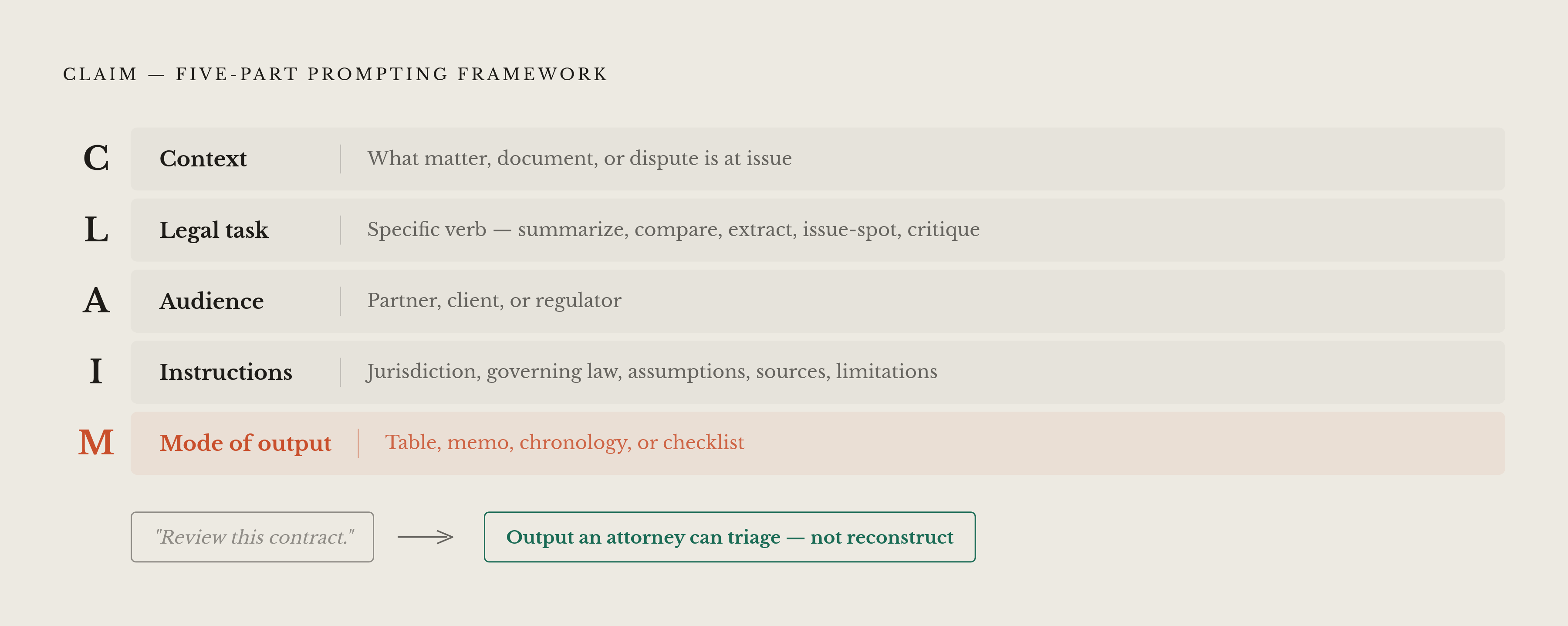
A better structure breaks the request into five parts, sometimes shortened to the acronym CLAIM: Context (what matter, document, or dispute is at issue), Legal task (a specific verb like summarize, compare, extract, issue-spot, critique, not a vague "review this"), Audience (a partner reads differently than a regulator, and the AI needs to know which one it's writing for), Instructions (jurisdiction, governing law, assumptions, sources, review standards, limitations), and Mode of output (table, memo, chronology, checklist).
The gap between the two approaches becomes visible quickly in practice. "Review this contract" tells the AI almost nothing and returns a wall of generic commentary nobody can act on. Compare that to a prompt that specifies the document is a vendor agreement reviewed from the perspective of a U.S.-based enterprise customer, lists the risk categories to flag (commercial terms, privacy, data security, indemnity, limitation of liability, termination, assignment), and asks for a table with clause reference, issue, business impact, suggested revision, and priority level. That second prompt produces something an attorney can actually triage against a deadline. Same document, same model, wildly different output. Attorneys who prompt with that structure get results that need editing, not reconstruction, and that gap is the whole distance between AI as a tool and AI as a liability.
Prompting approaches for general-purpose AI versus purpose-built legal AI
Structure alone doesn't solve the harder problem, which is where the information goes once it's typed in. Paste a client's merger terms into a consumer chatbot, and nothing guarantees that text stays put. It may get processed, stored, or folded into training data well outside the attorney's control, and no amount of clever prompt architecture undoes that once it's happened.
A federal court has already ruled that documents generated through public AI tools fall outside attorney-client privilege. That confidentiality question is now a matter of live legal exposure, not a hypothetical. California's 2026 guidance says as much directly: a lawyer can't input confidential information into an AI system without informed client consent covering the specific risks. That means actually reading the vendor's terms of use, privacy policy, and data handling documentation before a single client fact goes into the box.
Some attorneys try to split the difference by anonymizing: swap "Acme Corp" for "[Company A]," generalize the fact pattern, strip out names. It works, to a point. But AI models reason better with more detail, not less, so stripping out identifying information tends to weaken the analysis right when the stakes are highest. That's a real tradeoff, not a workaround, and pretending otherwise sets attorneys up to either compromise confidentiality or accept worse output. Pick one. Don't pretend both problems disappear because a name got swapped out.
Purpose-built legal AI tools, designed from the ground up around law firm data handling requirements, sidestep part of this problem structurally. Even there, prompting discipline still matters just as much. A closed system with poor data governance is still a closed system with poor data governance, and the label "built for lawyers" doesn't fix a vendor's sloppy retention policy.
Confidentiality, billing, and disclosure obligations that prompting standards must address explicitly
Confidentiality is the risk attorneys run into daily, often without noticing it. Data typed into an AI system can end up shared in ways the user never anticipated, security may be thinner than assumed, and a breach can happen through the prompt itself or through an uploaded document that never should have left the firm's own servers. California's 2026 guidance addresses all three of these directly.
Billing raises a separate, quieter set of questions. A general AI subscription that a firm pays for across every matter typically counts as overhead, the same as a legal research platform license or office rent, and can't get billed to a specific client on top of the hourly rate. Costs incurred specifically for one client's matter work differently: they can pass through, but the fee agreement needs to say so upfront. Fees have to reflect the actual cost incurred, not a markup dressed up as a service fee, unless the client has given informed written consent to something else. None of this is exotic. It's the same logic firms already apply to expert witness costs or courier fees, just applied to a new line item.
Disclosure to clients deserves the same weight as disclosure to courts, and it belongs in engagement letters, matter protocols, and outside counsel guidelines rather than a one-off conversation at intake. AI capability shifts month to month right now, and a disclosure written in January may not describe what the tool actually does by June. Treat disclosure as a standing practice, revisited on a schedule.
Disclosure to tribunals is the least negotiable of the three. Proposed Comment 3 turns citation-checking into a specific, named duty: no filing should contain a citation the responsible attorney hasn't read and verified. An AI system can draft the brief. It cannot carry the duty of candor on its own, because the rule doesn't attach to the drafting tool. It attaches to the license holder who signs the filing.
Turning individual prompting skill into institutional practice: prompt libraries, governance frameworks, and supervision structures
The adoption numbers and the governance numbers tell two different stories, and the mismatch is the real story here. In 2025, 88% of organizations used AI in at least one business function, but Economist Impact research found only 8% had anything resembling a full AI governance framework in place. Law firms aren't an exception: 86% of law firms and corporate legal departments plan to fold generative AI into routine legal work within two years. Most of an industry is running ahead of its own guardrails. The governance infrastructure needs to catch up fast, or the sanctions and disciplinary cases currently in the hundreds climb into the thousands.
Prompt libraries are the practical fix, and they work the same way a firm's form bank or precedent database has always worked. A successful prompt built during a real matter gets pulled out, stripped of client-specific detail, and turned into a template with variables for jurisdiction and document type. That template goes into a searchable repository organized by practice area and task type, tagged with version history, risk level, required verification steps, sample inputs and outputs, an assigned owner, and a review date. Done properly, the library becomes more than a shortcut. It's where institutional memory about how the firm negotiates indemnity clauses or handles limitation of liability language actually lives, so that knowledge doesn't walk out the door when a senior associate leaves for another firm.
Supervision has to run alongside the library, not instead of it. AI-generated work product needs the same review chain a junior associate's first draft would get, and governance frameworks should spell out, by task type and risk level, exactly who signs off before an AI-assisted document goes anywhere near a client or a court.
How prompting standards shift legal's role from document processor to contract intelligence function
Corporate legal has been drifting away from its old identity as a cost center and toward something closer to a strategic function, and the numbers back that up. 76% of legal peers expect AI to slash expenses, and the C-suite increasingly treats legal as a lever on growth rather than a line item to trim. AI tools reportedly hand in-house lawyers something like 14 hours a week back. What happens with those 14 hours depends entirely on whether the function around them is built to capture the gain or just absorb it as slack.
That's the real stakes of prompting standards, once you zoom out from the individual attorney. When every lawyer in a department builds a private way of talking to the AI, the speed gains are real but the intelligence gains disappear. Every negotiation throws off data: patterns in counterparty demands, recurring fallback positions, terms that always get struck. None of that data is usable if every attorney's prompts are shaped differently and the outputs don't line up with each other.
Standardized prompting fixes this by forcing consistent output: tables with the same columns, issue lists with the same categories, risk rankings on the same scale. Contract data becomes comparable across deals instead of trapped inside individual documents. Once that happens, patterns in counterparty behavior and negotiation outcomes stop being anecdotes traded at the coffee machine and start being data a legal department can actually query. That's what prompting standards are really driving toward: not faster document review, but a legal function that sees its own portfolio clearly enough to negotiate the next deal better than the last one.