Connecting Contract Intelligence to ERP and CRM Workflows
Automating contract terms into ERP and CRM enforces what legal negotiated.
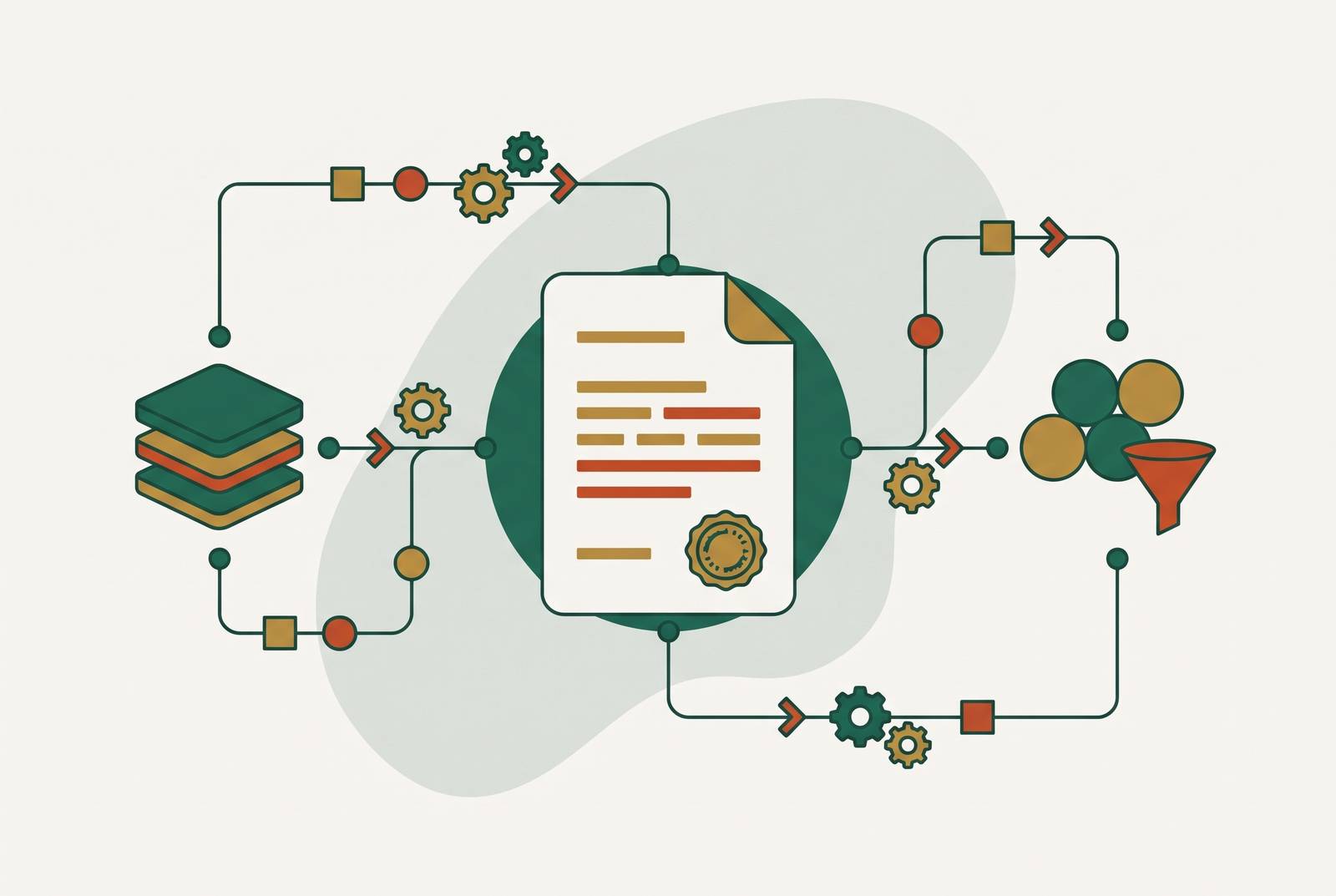
Connecting contract intelligence to ERP and CRM workflows closes the gap between what an organization agrees and how it operates. Its full value depends on obligation data, payment milestones, renewal triggers, and commercial terms reaching the systems that enforce them. Bidirectional integration makes that possible, but legal must first define which terms move, what they mean, and who governs them.
Why contracts sitting in a CLM but disconnected from ERP and CRM are only half the problem solved
Storage and activation are two different problems. Most organizations have a repository, captured signatures, and somewhere to find the executed agreement. Yet the commercial obligations inside that agreement often remain separate from the systems where finance, procurement, and sales make decisions. A complete contract record does not, by itself, change the rate used on an invoice or the terms used in a new quote.
The resulting failures are not failures of filing. Legal may hold the latest agreement while finance bills against outdated rates, procurement overlooks vendor spending caps, and sales creates quotes without visibility into existing commitments. SutiSoft's analysis identifies the underlying failure as legal, finance, and procurement operating on separate datasets, producing duplication, inconsistencies, and blind spots. Revenue loss, compliance violations, and manual reconciliation follow from that separation. A CLM implementation that stops at storage therefore leaves the work of translating agreements into operational decisions unresolved.
What contract data actually needs to travel, and where it needs to go
ERP needs the terms that govern financial and supplier performance. Payment milestones and schedules let accounts payable and receivable use the timing agreed in the contract, while pricing tiers, discount structures, and spending caps show how contracted rates differ from list prices. Delivery deadlines and SLA thresholds give operations teams the basis for planning and triggering remedies when a supplier breaches. Renewal and expiry dates serve a different purpose. They allow procurement workflows to begin before auto-renewal locks in terms that the organization would otherwise renegotiate.
CRM needs the terms that govern the customer relationship. Sales representatives can use negotiated commercial terms to draft amendments and expansions that go beyond the standard template. Renewal dates and auto-renewal triggers allow customer success and account management teams to intervene before churn or an unfavorable renewal. Negotiation history adds the context behind the agreement. It shows which concessions were made, which terms were held firm, and what the customer sought, rather than leaving the next deal team with only the final wording.
These destinations serve distinct but connected decisions. SutiSoft describes ERP as the backbone of financial management, where direct contract data supports real-time tracking of obligations, payment terms, and revenue forecasts. Malbek's integration guide identifies the corresponding revenue cycle problem when CRM and CLM operate independently. Sales creates quotes without the existing contract terms, while legal reviews agreements without knowing the deal strategy or the customer's history. Treating all contract data as one undifferentiated feed misses these different uses.
The return flow is equally important to accuracy. CRM opportunity data, including customer details, pricing, and deal structure, should populate contract templates without re-keying. ERP vendor and supplier records should similarly inform procurement contracts. Malbek's CLM integration overview describes a single source of truth in which negotiated terms and renewal dates enrich CRM records while ERP enforces contract pricing and payment terms. Bidirectional integration connects contract creation to the business record and sends the resulting commitments back into operational use.
How the technical connection between CLM, ERP, and CRM actually works
APIs provide the connection, but the exchange design determines its usefulness. Pre-built connectors to enterprise systems can reduce implementation risk and distinguish a two-to-eight-week integration from a multi-month custom build. Timing is a separate design choice. Real-time synchronous exchange lets an invoice use current contract terms, while scheduled batch updates can keep an amendment out of reach until the next synchronization. An invoice processed before tonight's update may therefore use terms that have already changed.
Direction also determines what the connection can accomplish. A unidirectional feed into CLM makes it a receiver, whereas obligation enforcement requires it to act as a source of contract data. Bidirectional synchronization supports both roles, bringing business information into contract creation and returning negotiated terms to the systems that use them. A connector's existence does not establish either its direction or its timing.
Malbek's enterprise integration guide describes CRM connections for Salesforce and Microsoft Dynamics 365 that populate templates with opportunity data, customer details, and pricing. Contract status is shown alongside the progress of the deal, and renewal alerts are triggered by the dates when contracts end. Procurement uses a different exchange. The same guide says SAP Ariba integration links the workflows for procurement review and vendor agreements so supplier data, spending caps, and performance obligations can move between systems. SutiSoft identifies native connectors to SAP, Oracle, NetSuite, and Microsoft Dynamics as part of the broader baseline for CLM selection.
The extraction layer determines the quality of what moves. If clause language is mapped to the wrong structured field, integration propagates that error. Malbek's 2026 contract intelligence overview describes ensemble LLM architectures, in which multiple models cross-reference outputs, and retrieval-augmented generation, which grounds responses in retrieved contract language. These approaches help make extracted payment milestones, renewal dates, and pricing tiers reliable enough to enter financial workflows without someone having to check them first. Their significance is not simply faster extraction, but whether the resulting fields are dependable enough for operational use.
Field mapping remains a legal and business judgment. Payment terms, obligations, and renewal dates must correspond to specific ERP and CRM data points. Legal and IT therefore share responsibility for the connection's meaning as well as its mechanics. Scale adds another requirement. The architecture must handle growing data flows, multiple currencies, regional compliance needs, and legacy systems without having to be redesigned as the number of contracts and the need for integration grow.
Why enterprise organizations face integration obstacles that smaller companies rarely encounter
Malbek's enterprise guide identifies mergers and acquisitions as a source of disruption because newly combined entities require system consolidation and workflow redesign. Existing CLM processes must fit how the combined organization works as well as connect to another application. Global operations create a related challenge. Contract terms, currencies, and compliance requirements differ by region, so a single integration model rarely works everywhere without being configured for each.
Older ERP or CRM systems may have to remain in place while connecting to a modern CLM platform. REST APIs, legacy SOAP interfaces, and proprietary schemas create technical mismatches that complicate the exchange. Procurement adds time before implementation can begin. Enterprise vendor selection cycles routinely add months, so integration planning cannot wait until a system has been selected.
An enterprise may already operate CLM, ERP, CRM, and procurement tools without a single validated view of its contractual commitments. Without governance, connecting those systems only makes records that disagree move faster. CobbleStone's 2026 CLM trends analysis describes the shift from contract storage units to contract intelligence hubs expected to surface intelligence actively. That expectation raises the stakes for integration quality, but the obstacles remain manageable when planning establishes the intended outcomes, data ownership, and workflow rules before technical implementation.
What legal teams need to plan before integration goes to IT
Legal teams should first decide what they want the integration to achieve. Making financial reports more accurate, tracking compliance obligations, improving procurement, and speeding up the revenue cycle each call for different fields and different choices about what comes first. The selected objective should determine which systems enter scope and in what order. SutiSoft identifies clarifying goals before field mapping as an early planning step. Without that decision, a technically functional connection can still enforce the wrong terms or omit the obligations the project was meant to address.
Next, legal should identify the clauses that supply the required data and map them with finance or procurement. Payment terms, renewal dates, SLA thresholds, spending caps, and delivery deadlines must fit the target system's data structures without losing their contractual meaning. This work requires joint decisions. The same discussion must define what happens when an amendment changes a field already in use in ERP. An update workflow agreed before go-live avoids leaving that question to the first billing dispute.
Governance must then establish which records are authoritative. Legal should define the source of record for each data type and the remediation process when systems disagree. A single validated source of contractual truth is a prerequisite for connection. The integration can distribute an agreed record, but the organization must first decide which record deserves that status.
With those rules defined, the affected functions should agree on how the fields enter their workflows. Finance must specify how payment milestones appear and are enforced in ERP. Sales operations must agree on the contract information shown in CRM and the handling of renewal alerts. Procurement must confirm how vendor obligations fit into the workflows used for spend management. These decisions prevent each function from configuring the connection around its own defaults while leaving gaps between teams.
Security review must also precede the connection itself. Each integration point can expose confidential contract data, so legal must check the vendor's data handling policies, sub-processor lists, and certification status before the connection is set up. For regulated industries, architecture choices such as inference-only AI that does not use client data for model training are contract requirements. Deferring them risks a compliance gap in the handoff. IT should receive a defined set of outcomes, mappings, ownership rules, workflow decisions, and security requirements, rather than responsibility for deciding what the contracts require.
What the integration actually changes for finance, procurement, and sales — and what it changes for legal
When ERP automatically enforces payment milestones and pricing terms, it removes the billing errors caused by disconnected contract data and the disputes those errors cause. It also changes the basis of forecasting. Real-time visibility into obligations allows revenue forecasts and cash flow projections to reflect actual commitments.
Vendor caps, SLA thresholds, and performance commitments become available inside ERP, allowing managers to monitor compliance without switching systems. Timing improves the scope for commercial action. Renewal alerts can start renegotiation before auto-renewal, while spend analytics tied to contract terms can show which discount clauses apply to actual spending. Procurement can then approach renegotiation with both the contractual entitlement and the spending context in view.
Contract status, key terms, and renewal dates become available inside CRM rather than requiring account managers to reconstruct commitments from separate systems. Malbek's enterprise guide describes how amendments update CRM records in real time so customer success teams can use the current terms. Negotiation history adds continuity when representatives change roles. The concessions and positions behind earlier agreements remain available to inform future deal strategy instead of leaving with the person who negotiated them.
Legal also has fewer follow-up requests to handle. When obligation data reaches the systems that enforce it, legal moves from chasing performance to defining the rules through which performance is managed. A view across the portfolio also shows where risk is concentrated, where favorable terms are most common, and which counterparties keep seeking non-standard language. Legal can use those patterns to shape the next hundred agreements and review each with the others in mind. The technical connection and planning discipline earn that strategic role by making legal judgment reusable across the organization and its downstream effects measurable.