Contract Metadata Taxonomy Design for Enterprise Legal Teams
Structured metadata design transforms contracts from documents into queryable business data.
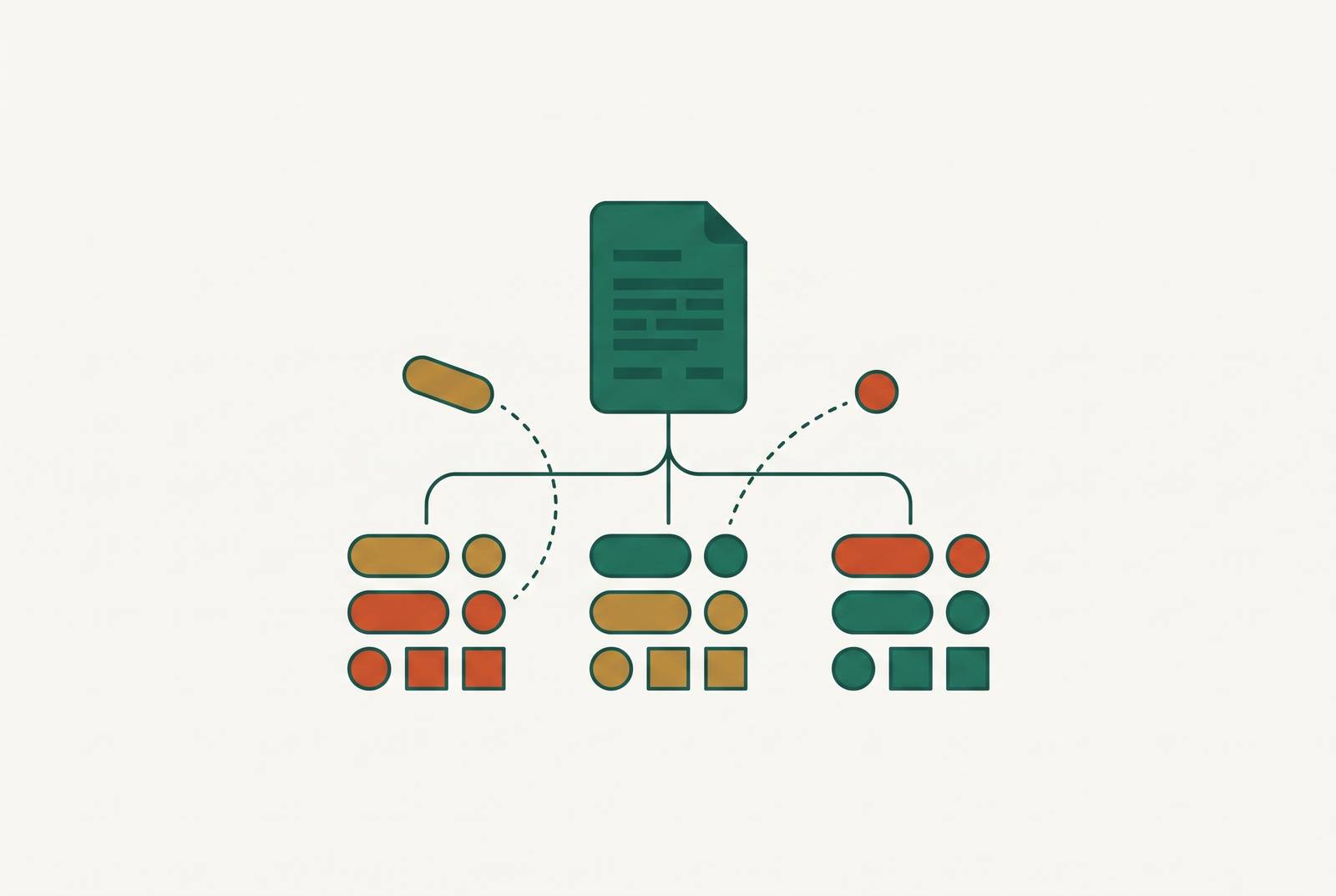
An enterprise legal team needs sound contract metadata taxonomy design to turn its agreements into actionable business intelligence. The task is to make contracts easier to find and define the fields, rules and ownership that make portfolio-wide questions answerable, then preserve that structure as contracts change and automation expands.
Why contracts remain unreadable at the portfolio level despite years of CLM investment
A legal ops lead or GC asked for a clean renewal-risk report can still face a document-by-document review, even after substantial investment in contract lifecycle management platforms. The contracts are centralized, but the answer is not. Finding every vendor contract renewing in Q3 with auto-renewal clauses takes information about contract type, dates and renewal terms that is recorded the same way. A folder of PDFs cannot supply that structure by itself.
Storage and structure solve two different problems. If sales operations records an agreement as “MSA” while legal records it as “Master Services Agreement,” reporting by contract type becomes unreliable even when both teams use the same repository. Centralization makes documents accessible, but a defined metadata schema makes their contents queryable. The gap is therefore not necessarily another platform capability. It is agreement on how the portfolio will be described.
What a metadata taxonomy actually is, and why its design determines everything downstream
A metadata taxonomy is the schema that defines what the contract portfolio can answer, for whom and with what reliability. It specifies fields, their meanings and the values they permit. That makes it more than a signature-stage form. A field called “date” captures less useful information than one that distinguishes an effective date from a renewal date, because the distinction determines which business question the value can answer.
These choices constrain every later use of the data. Fields omitted before migration cannot be reconstructed reliably at scale without returning to the underlying contracts, while poorly defined fields can produce consistent labels that remain unsuitable for analysis or AI extraction. Consistency alone is not enough. Once procurement, finance and business units rely on a field, its definition also becomes an organizational commitment. Changing that definition mid-deployment can invalidate historical comparisons and break dashboards, so the architecture needs to precede both migration and reporting.
The four tiers every enterprise taxonomy must cover, and the two fields most teams omit
The practical framework has four tiers, each serving a different set of decisions. Tier 1. Administrative includes contract ID, owner, business unit, counterparty name, contract type and signed status. These fields establish basic portfolio visibility. Counterparty names need normalization, because “Acme Inc.” and “Acme, Inc.” otherwise produce separate records for the same entity. Tier 2. Commercial adds contract value, pricing structure, payment terms and currency so finance and procurement can track spend and reconcile rebates.
Tier 3. Lifecycle has fields for effective date, expiration date, renewal terms, termination rights and notice period. Auto-renewal needs an explicit designation and its notice period. An expiration alert left in the inbox of someone who has departed can otherwise lead to committed spend without a decision. Tier 4. Legal and compliance covers governing law, risk tier, indemnification scope, confidentiality terms, IP ownership and jurisdiction-specific obligations. Counsel must approve these definitions, including distinctions such as “Payment Amount” versus “Liability Cap,” rather than leaving legal meaning to a data or operations team.
Two omissions deserve attention during the initial design. Teams need to agree on low, medium and high as the values for risk tier, and auto-renew, manual and none for renewal type. Neither belongs in an indefinite later phase. Their absence prevents risk reporting and proactive renewal management, respectively. Risk tier also cannot be back-filled reliably by AI until counsel has agreed what each category means.
Why fewer, accurate fields beat more, incomplete ones — and how to sequence the build
A smaller set of accurate fields produces more usable intelligence than an extensive schema populated unevenly. Incomplete data weakens trust in the resulting reports. The practical sequence is to stabilize Tier 1, administrative and Tier 2, commercial, validate their completeness and accuracy, and then expand into Lifecycle and Legal and compliance. This sequence governs implementation within the full scope of the initial design.
Each expansion needs an owner accountable for data quality. Field owners need to enter values correctly at signature and keep them up to date after amendments. Controlled vocabularies for contract type and governing law enforce consistency at intake. Without that discipline, adding fields only creates more places for variation to accumulate.
For a migration project, the starting point is an audit of where contracts currently live, before system selection or configuration. The schema comes before the move. Defining it afterward requires retroactive extraction across the corpus, which is expensive and often inaccurate. Legacy contracts should then be prioritized by value and renewal proximity rather than alphabetically, with agreements expiring or auto-renewing soonest extracted and validated first.
How folder structure and naming conventions are taxonomy decisions with portfolio-wide consequences
Folder organization determines how easily a team can move from finding one agreement to analyzing many. Vendor-based folders work against that transition when they substitute for structured fields. A request to find all MSAs with auto-renewal clauses expiring in Q2 crosses vendor boundaries and requires traversing every folder. Each new vendor adds another place to check. Contract type and business unit provide more useful organizational axes for both retrieval and portfolio analysis.
Abbreviations and synonyms are not harmless if reports treat them as separate categories, so a maintained controlled vocabulary needs to apply at intake. The organizational boundary is equally important. When legal, procurement and finance maintain separate trackers, they can produce partial and contradictory accounts of the same portfolio. A shared taxonomy with role-based access supports their different uses without creating competing definitions of the underlying agreements.
Where AI extraction fits in the taxonomy — and where it requires human judgment first
AI extraction applies a defined taxonomy to a large set of contracts. It does not decide what the fields should mean. Legal documents combine parties, defined terms, monetary values, jurisdictions, clause types and relationships between those elements. Accurate extraction therefore depends on descriptions that specify legal context, rather than generic labels that leave the target ambiguous. Better field definitions can improve output without model customization.
Reliability also varies by the clause being extracted. Limitation of liability, payment terms, termination rights and confidentiality tend to follow patterns that are easier to predict. IP ownership and complex indemnification need more precise boundaries to avoid over- or under-extraction, while jurisdiction-specific terms have uneven accuracy because some legal traditions are under-represented in training data. The review process needs to account for those differences.
The governance precondition is a risk taxonomy agreed with counsel and fixed in the output schema before extraction begins. A floating definition of risk undermines reliable classification and can contribute to unsupported legal references. Confidence-based routing then separates high-confidence extractions from low-confidence or red-flagged clauses that require lawyers. Disciplined metadata standards and clause taxonomy remain prerequisites for agentic workflows as automation expands.
How playbooks connect taxonomy design to autonomous clause handling at scale
A playbook translates taxonomy definitions into decisions about acceptable language, escalation and autonomous handling. The connection must be explicit enough to apply. A field labeled “limitation of liability” supports automated handling only when its definition and associated rules distinguish variations within policy from non-standard language. Identifying the clause is an extraction task. The policy layer is needed to decide whether its terms are acceptable.
A majority of clause changes in a typical commercial negotiation can fall within a well-designed company playbook. Within that coverage, AI can accept pre-approved language, propose fallbacks and generate counter-language consistent with policy, while the remainder escalates to lawyers. Without a playbook, autonomous coverage drops sharply. The precision and reach of the rules constrain how the system can act on the contract language it reads.
That coverage also needs protection against playbook creep. AI calibrated against legacy agreements can gradually normalize non-standard clauses as acceptable. Regular audits against the taxonomy address this by checking whether the rules in use still match the approved definitions. Standardized templates support consistency in drafting, while the playbook applies that consistency to clause variations at scale.
What taxonomy-enabled intelligence looks like in practice — portfolio signals only structured data can surface
A team may need to understand how tariff clauses appear across its agreements. Structured clause metadata makes that pattern queryable across thousands of agreements. Without it, the same inquiry remains a review exercise.
Dated obligations show how that visibility becomes operational. Notice windows, SLA commitments and price-review triggers can stay buried in signed contracts unless the taxonomy records them in structured fields. Those fields can connect to workflows that generate reminders and assign owners. The contract then supplies information for a decision while there is still time to act.
Procurement can check supplier commitments against what was spent, while finance can see renewal exposure and termination costs before they come as a surprise. Compliance can shift audit-evidence reconstruction from email chains to fields. These are different uses of one shared dataset, rather than separate reporting projects built from repeated document review.
The governance layer that keeps taxonomy reliable as the portfolio grows and teams change
A taxonomy can be sound at launch and still degrade. Definitions drift, owners leave and extraction systems encounter the variation that accumulates. Governance preserves the value of the original design by controlling those changes. For high-variance fields such as contract type, counterparty name and governing law, a maintained vocabulary needs a defined owner who approves additions. Otherwise, local naming choices gradually fragment the shared dataset.
Amendments need their own checks because a record that was accurate in the past may no longer be up to date. An amendment-triggered workflow needs to update affected metadata when the agreement changes. Playbook audits address another form of drift. They test whether repeated use has normalized non-standard language without an approved policy decision.
AI autonomy also needs documented boundaries before launch. Counsel must agree which outputs can pass through, which require human review and which need senior counsel sign-off. The EU AI Act and GDPR create concrete compliance requirements for enterprise teams using AI extraction on contracts in or involving EU jurisdictions. Those requirements add to the need for risk assessment and compliance monitoring. With defined escalation tiers, legal can keep expanding autonomy aligned with governance under explicit controls.
How taxonomy maturity shifts legal from reactive reviewer to strategic intelligence function
Taxonomy maturity changes where legal applies its judgment. Instead of interpreting the same portfolio questions manually, the function defines fields, playbook rules and escalation thresholds that govern agreements throughout the system. Individual review is still needed when a decision calls for judgment.
A clean renewal-risk report, compliance audit trail or spend-by-vendor analysis supplies finance, procurement and leadership with information they can use without commissioning another review exercise. Credibility comes from the reliability of those answers. It also depends on preserving the definitions and ownership that produced them.
For a team without a defined taxonomy, the starting point is a small, accurate foundation for basic renewal management and portfolio reporting. Administrative and Commercial fields need to stabilize before broader implementation, while the full design accounts for Lifecycle and Legal and compliance needs. Expansion follows demonstrated completeness and accuracy. The aim is not to describe every contract feature immediately, but to build a dataset on which consequential business decisions can depend.