Obligation Extraction From Commercial Contracts
AI and rules-based systems turn contract commitments into searchable data.

Obligation extraction turns the dense legal language in commercial contracts into an organized list of commitments. Its value depends on more than finding clauses accurately. Legal teams need to understand what extraction captures, where human judgment remains necessary, and how the resulting data reaches the people responsible for performance. That combination makes contract oversight possible at scale.
What obligation extraction is and what it actually does to contract text
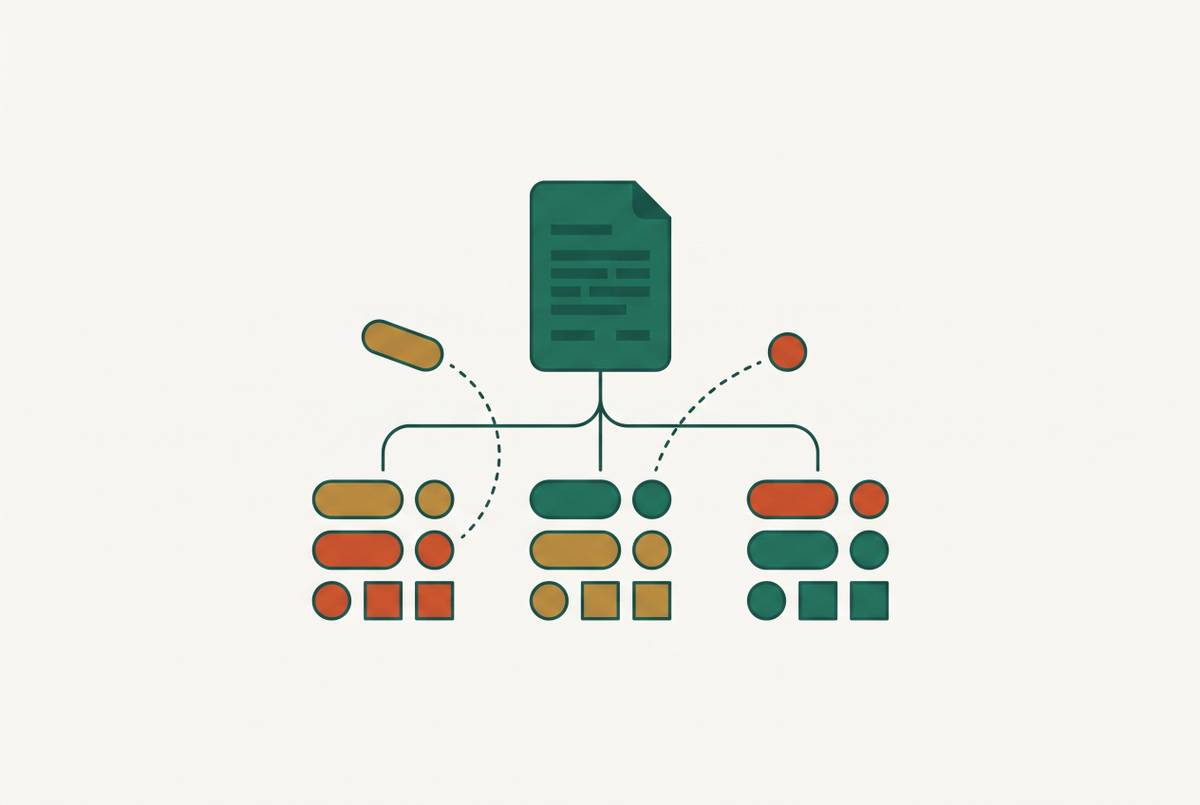
Obligation extraction identifies, pulls out, and structures the commitments embedded in contract language, including deliverables, deadlines, payment terms, service levels, and compliance duties. It converts unstructured prose into fields that can be queried and analyzed. The text it works with may have defined terms, nested cross-references, or financial tables, or come from scanned PDFs. The output puts those commitments into named fields and keeps the context needed to understand them.
Volody's 2026 guide explains that a clause stating “this agreement automatically extends for successive one-year terms” can be identified as a renewal obligation without using the word “renewal.” Recognition depends on meaning. The same distinction applies when payment duties or performance requirements appear through defined terms.
Extraction also picks out parties, governing law, termination rights, and liability caps. Not every field is an obligation. iWeaver's 2026 guide groups foundational contract data into parties, consent, consideration, conditions, and compliance. Within those categories, obligations are the commitments each party must perform, and they are the highest-stakes extraction target because missing them creates direct legal and financial exposure.
Why contracts become illegible at scale and what gets missed without extraction
An obligation left inside a static document can escape attention even when the agreement itself is accessible. A renewal notice deadline passes, triggering an unwanted extension. A financial commitment remains unmonitored until a counterparty raises a dispute. An SLA breach goes undetected until service credits are claimed, while a compliance gap is detected only during an audit.
Distributed visibility compounds the difficulty of tracking obligations in long documents. SpotDraft's 2026 compliance guide identifies scattered repositories, inconsistent obligation language, spreadsheet tracking, and siloed teams as the main drivers. Legal, procurement, finance, and operations may each hold part of the contractual picture without anyone holding all of it. Faster deal cycles, globally distributed teams, and cross-border engagements increase both the volume of agreements and the pace at which commitments accumulate.
Some agreements never enter that picture at all. The same guide describes “shadow contracting,” where business teams create agreements through email, messaging tools, or outdated templates outside the legal workflow. Those commitments remain invisible to the tracking system. Volody's guide describes the consequence as reactive management, with teams addressing problems only after they occur. Better individual review cannot close this leakage when the obligation never reaches a shared record.
The two extraction methods and why modern platforms combine them
Rule-based extraction uses predefined templates, patterns, and regular expressions to find specific data points. It works well with standardized NDAs and procurement agreements whose wording and layout remain consistent, and its rules are easy to audit. Variability is its principal weakness. Those patterns fail when formats are non-standard, and someone may have to create another template by hand for each new contract type.
AI/ML-based extraction uses transformer-based large language models to find data by looking at its context. That approach accommodates differences in wording, contract type, and language. The 2026 platform benchmarks place leading AI platforms at 85–94% accuracy for clause extraction from well-formatted standard commercial agreements, with lower confidence on unusual structures. iWeaver's guide describes modern solutions combining rules for predictable formats with machine learning for variability, without requiring manual model training.
Optical character recognition turns scanned images into text before natural-language processing can extract what they contain, but skewed text, faded ink, and poor scans still get in the way. Tables, rate cards, and service level schedules also need parsing that is designed for them. Reading a sentence correctly is insufficient when its effect depends on a definition, exhibit, or cross-reference elsewhere.
Malbek's 2026 platform overview describes an ensemble approach in which multiple LLMs cross-reference and reconcile outputs across paragraphs, tables, and exhibits. It presents this architecture as a means of eliminating hallucination while retaining review. The overview also describes retrieval-augmented generation, which retrieves relevant contract language before generating an answer about a term such as a price escalation cap. Confidence scoring then helps route the results so that high-confidence fields move on automatically and low-confidence or flagged clauses go to an attorney.
What obligation extraction actually captures across a commercial contract portfolio
A structured inventory includes the information needed to identify who owes what, when performance is due, and what conditions apply. Parties and signatories provide entity names, authority levels, and notice addresses. The fields for key dates hold effective dates, renewal windows, and termination notice periods. Financial fields capture payment schedules, escalation clauses, penalties, liability caps, and indemnification limits, while performance fields identify deliverables, SLA thresholds, service credits, and milestone-based payment triggers.
The emphasis changes with the agreement being processed. In MSAs and SOWs, much of the commercial risk lies in liability caps, IP ownership, service credits, and change-order provisions. Malbek's overview describes extracting these clauses and comparing them with an organization's standard playbook to surface deviations. For teams with large volumes of supplier agreements, confidence-based routing offers a way to cut routine review right away. For NDAs, more of the focus is on non-disclosure scope and permitted use restrictions.
Compliance fields add data protection requirements, certifications, audit rights, and reporting duties to the inventory. Termination fields identify for-cause triggers, for-convenience windows, and cure periods. Volody's guide describes metadata such as contract type, status, governing law, and obligation owner making these records searchable and reportable across a portfolio. Extraction alone cannot clear up a commitment whose wording is ambiguous or work out how every cross-referenced condition applies. A grammatically identifiable duty may remain commercially unclear.
Where AI extraction reliably replaces manual review and where it cannot
AI extraction can replace routine manual identification of defined terms, dates, financial figures, and standard clause types in well-formatted commercial agreements. These are bounded tasks with identifiable outputs. The system is answering what the contract says about a particular field, rather than deciding whether that position is acceptable. That distinction defines the reliable scope of automation.
iWeaver and Volody distinguish extraction from contract review. Finding a liability cap is not the same as deciding whether it fits the organization's risk threshold. High-confidence standard fields can therefore pass through the extraction workflow without attorney involvement, while uncertain results and red flags escalate. The later business decision may still require human review even when the extracted field does not.
An OCR error can degrade downstream extraction, while a conditional obligation may require interpretation across schedules, definitions, and exhibits. Ensemble architectures address document-wide context but do not remove every ambiguity. The useful analogy is a first-year associate's extraction work, with the retrieved text supporting rather than replacing a judgment about contractual acceptability. Volody's guide describes a feedback loop in which reviewers' corrections improve extraction accuracy over time, making active use part of both the system's development and its deployment.
How extracted obligation data feeds downstream compliance, renewal, and risk workflows
Extracted dates and milestones become operationally useful when they trigger action before performance is due. Procurement teams can get alerts in their calendars for auto-renewals and notice deadlines captured at signing. Finance teams can check invoices against payment terms without having to open each agreement. Volody's guide describes these uses as a move from document lookup to ongoing obligation tracking. Payment milestones, escalation triggers, and penalty provisions also feed forecasting and committed-spend analysis.
Compliance monitoring follows the same shift in practice. Extracted regulatory clauses, data protection terms, and audit provisions can populate continuous dashboards, replacing periodic manual checks. SpotDraft's guide connects that need to new data protection regimes, tightening GDPR interpretations, and AI governance frameworks.
Portfolio queries extend the use beyond individual deadlines. Legal teams can identify supplier agreements with uncapped liability, contracts approaching auto-renewal, or MSAs whose data-processing duties implicate a new regulatory requirement. Malbek's overview frames this as contract intelligence. Its usefulness depends on reaching the functions that can respond, because procurement, finance, sales, IT, operations, and vendor management are accountable for different commitments. Data confined to a legal dashboard does not close that gap, so integration with CLM systems, ERP platforms, and business intelligence tools is part of the compliance workflow itself.
What effective rollout of obligation extraction requires in practice
Volody's implementation guidance recommends starting with five to ten key fields in one contract category. The first category should be the type of agreement with the highest volume and lowest risk that now takes up attorney time, usually NDAs or standard supplier agreements. Keeping the deployment small lets teams see its value before they expand it.
Governance belongs at the start of that deployment. The minimum includes an approved tools policy, a data handling protocol, a human-in-the-loop requirement for outputs that drive business decisions or reach counterparties, and a mechanism for correcting errors. This distinguishes automated data capture from accountable use of the result.
SpotDraft identifies scattered contract data as a primary obstacle, making centralization, consistent metadata, and standardized repositories prerequisites for portfolio-scale extraction. Attorneys also need to see time recovered in their own work, rather than hear only an organizational efficiency argument. Review of low-confidence fields and feedback on errors should remain part of the workflow, because a one-time setup does not provide the corrections that support improvement.
Ownership must extend beyond legal to the functions responsible for performance. Extracted commitments need named owners in procurement, finance, operations, and IT, together with integration into the systems those teams use. Intake controls must also bring agreements into the system of record at creation, since extraction cannot recover visibility into contracts it never receives. The sequencing test is whether the data lands where the accountable person can act on it.
How obligation extraction positions legal teams as portfolio-level risk managers rather than document reviewers
A queryable commitment portfolio changes the unit of legal oversight from the individual document to patterns across agreements. Malbek's overview explains that when contract volume doubles, legal teams cannot assume that headcount will double with it. Extraction supports oversight without proportional resource growth by separating routine identification from the judgments that require legal attention.
Extracted data can reveal how counterparties push back on standard terms across hundreds of negotiations, allowing legal teams to update positions from observed patterns. The same portfolio view can expose concentrations of uncapped liability within supplier categories or clusters of auto-renewing agreements in the same quarter. Those patterns are hard to spot when documents are reviewed one at a time, even when each agreement gets a careful review.
SpotDraft frames compliance as a cross-functional concern tied to revenue, vendor relationships, and audit readiness, while new data protection regimes, AI governance frameworks, and industry-specific mandates expand the obligations requiring oversight. Structured commitment data allows legal teams to present that exposure as a portfolio-level risk and opportunity picture. Extraction gives legal teams a broader, more usable basis for exercising judgment.