Measuring ROI From AI in Corporate Legal Departments
Most legal departments use AI without measuring whether it actually saves money or creates value.

AI use inside corporate legal departments has become the norm, the ability to show what that use is worth has barely moved, and Thomson Reuters' 2026 research puts a number on the gap: 82% of legal departments either do not measure AI's return on investment or cannot say for certain whether they do, even as AI use has become widespread among general counsel and chief legal officers. That combination, near-universal adoption paired with almost no accounting for what it produces, is a compounding risk. It is a compounding risk: legal leaders cannot make good decisions about what to buy next, cannot defend the budget they already have, and cannot answer a straightforward question from the CFO or the board about what any of it bought. The legal industry is not indifferent to measurement. Legal departments are not indifferent to measurement; the market is moving faster than the ability to evaluate it.
Why the measurement gap persists
The gap holds even in departments that genuinely want to close it, and the reason has less to do with data availability than with sequencing. Most legal departments never define what success would look like before they buy a tool, and a framework built after the fact to answer a question no one asked at the outset tends to produce numbers that are hard to trust and harder to act on.
Three structural barriers reinforce one another. The first is strategy without purpose: many departments adopt AI because competitors already have it or because a vendor promised efficiency gains, without anyone mapping which workflows or business problems the technology was supposed to fix. Without that starting definition, there is nothing concrete to measure success against. The second barrier is a trust deficit. Concerns about accuracy and the risk of hallucinated output make lawyers hesitant to rely on AI for anything client-facing or reputation-sensitive, and that hesitation survives well past the purchase decision. A tool nobody trusts with consequential work only ever gets used on low-stakes tasks, which caps how much measurable impact it can ever produce. The third barrier is adoption without integration. Buying licenses is not the same as building AI into how people actually work day to day, and without role-specific training, redesigned workflows, and some mechanism for tracking outcomes, even a capable tool sits underused and its effects stay invisible.
Trust is a measurable predictor of outcome: legal teams with high trust in their AI tools report positive ROI at a dramatically higher rate than teams without that trust, yet only a small minority of legal professionals currently report high confidence in generative AI output, Legaltech News found. The gap reflects a structural barrier to measurement rather than the technology's capability.
In the absence of internal numbers, vendor-commissioned studies have rushed in to fill the space, but Legartis observes that such studies are without exception commissioned by the vendors themselves, and independently, only a small minority of law firms systematically assess whether their AI investments create value, so they make a poor substitute. A legal department walking into next year's budget cycle armed only with a vendor's own figures is going to face exactly the credibility problem that figure was supposed to prevent. What closes that gap starts with a clear-eyed distinction about what kind of value AI in legal actually produces, because measuring the wrong thing, or measuring one kind of value as if it were the other, is where most frameworks break down before they even get started.
The two kinds of value AI generates in legal (and why conflating them breaks measurement)
Legal AI generates two categorically different kinds of return, and treating them as one undifferentiated pool of "value" is the single most common reason measurement frameworks fail to produce defensible numbers.
Hard returns are the kind a finance department can look at and immediately understand. Reduced spending on outside counsel sits at the top of this list because it is the benefit CFOs see most directly. Time recovered from repetitive work such as contract review, document summarization, and legal research falls into this same category, since hours saved convert directly into dollar figures once multiplied against fully loaded attorney rates. So does the ability to absorb more matter volume without adding headcount, and any measurable reduction in the administrative load carried by paralegals and support staff.
Soft returns are strategic rather than transactional, and they are harder to put a dollar figure on, but they frequently represent the larger payoff over time. Earlier identification of unfavorable contract terms and faster escalation of high-risk clauses reduce exposure before it becomes a problem. Access to historical contract data lets legal build sharper negotiation playbooks and hold consistent positions across an entire portfolio instead of relitigating the same points deal by deal. Faster, more proactive responsiveness changes how the rest of the business perceives legal, shifting it from a function people route around to one they actually consult early. And systematically capturing negotiation history so that what one deal teaches informs the next builds institutional knowledge that would otherwise walk out the door with whoever closed the deal.
Thomson Reuters' research finds that most departments currently measuring AI gravitate toward the easy, quantifiable metrics and skip over the harder categories, things like improved research quality, more thorough analysis, and reduced risk exposure, even though that is where a large share of the real value actually accumulates. Separating hard returns from soft returns is what makes it possible to build a metric set that actually captures both.
A practical metric set for each category of return
Once hard and soft returns are treated as separate tracks, the metrics for each become straightforward to identify, even if not every department will want to track all of them at once. The goal is not to build an exhaustive dashboard. A department that picks three to five metrics it can consistently track will get more defensible results than one that tries to measure everything and sustains none of it.
For hard returns, a handful of measures do most of the work. Time-to-completion for high-volume contract tasks is one of the clearest: track average review time before and after AI deployment for a defined contract type, such as NDAs or master service agreements. Sources describing this comparison note that AI can get through a standard NDA in a fraction of the time manual review takes, which gives a department a concrete before-and-after number rather than a vague impression of speed. Outside counsel spend as a share of total legal budget, measured quarterly, is one of the clearest hard-dollar signals and the one most legible to CFOs and boards. Internal matter volume per attorney tests whether AI is actually freeing up capacity: if the technology is absorbing administrative work, attorneys should be able to handle more matters without logging more hours, and this ratio shows whether that capacity gain is real. Contract cycle time, measured from initial request through full execution, is another strong indicator, since industry data shows AI-assisted contract lifecycle management can shorten that cycle meaningfully, giving departments a clean before-and-after comparison. Rounding out the hard-return set, tracking paralegal and support-staff hours diverted away from formatting, routing, and status-tracking shows how much capacity has shifted toward higher-value work.
Soft returns need their own metrics, since none of the above will capture them. Playbook compliance rate, the share of negotiated contracts that land within pre-approved positions without requiring escalation, tells a department whether AI-assisted review is actually enforcing consistent standards across the portfolio. Risk escalation speed, the time between contract submission and identification of a flagged clause, matters because risk caught early is risk that is cheaper and easier to fix. Business partner satisfaction, gathered through a simple periodic survey of internal clients like sales, procurement, or HR on legal's responsiveness and usefulness, is admittedly a soft measure, but it tracks directly whether legal is becoming the kind of strategic partner those soft returns are supposed to represent. Knowledge retention matters too: whether negotiation outcomes and fallback positions are captured systematically and reused on the next deal, instead of lost the moment a deal closes.
Thomson Reuters' guidance on this point is direct: demonstrating success requires measuring outcomes, not counting technology licenses purchased. Licenses bought, tools deployed, and training hours logged are inputs. None of them, on their own, is evidence that anything of value actually happened.
A formal AI strategy is a prerequisite for realizing these returns
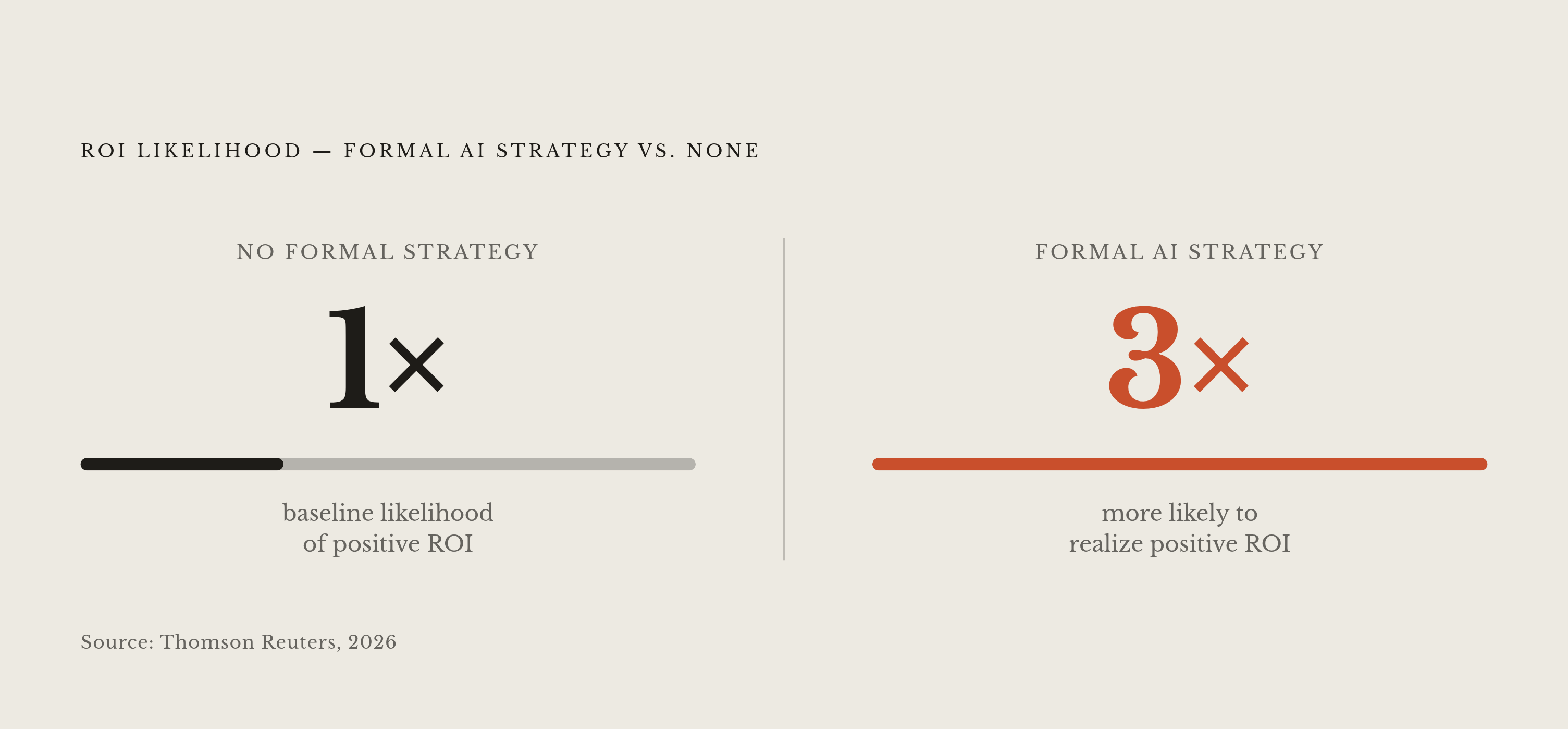
That condition is a formal AI strategy adopted before a tool is ever deployed, and none of these metrics mean much without it. The single strongest predictor of whether a legal department ends up with positive ROI from AI is the presence of a formal strategy before deployment, not which tool it picked. It is whether the department had a formal strategy in place before deploying it.
Thomson Reuters' 2026 research quantifies just how large that gap is: organizations with a formal AI strategy are more than three times more likely to realize positive ROI than organizations without one, a difference large enough to dwarf whatever separates one vendor's product from another's. A formal strategy accomplishes three things that adopting tools ad hoc cannot. It identifies which workflows AI is actually supposed to improve, and that identification is what creates a baseline against which any later improvement can be measured. It assigns clear ownership over tracking and reporting the resulting metrics, which is what turns measurement from a good intention into an ongoing practice. And it ties the AI investment to a specific business objective, whether that is cutting outside counsel spend, shortening contract cycle time, or handling more matters without adding headcount, giving a CFO or general counsel something concrete to evaluate rather than a vague promise of efficiency.
The number of legal departments with a formal technology roadmap has grown substantially, a sign the field is starting to absorb this lesson, but most departments still operate without one, and that is a large part of why adoption has climbed sharply while demonstrated ROI has not followed at the same pace. Legartis's 2026 maturity model describes an "Optimizing" stage where departments are actively tracking time saved, outside counsel spend reduced, and contract cycle time shortened, and it is only at that stage that the legal function starts to be seen inside the business as a strategic partner rather than a cost center to be managed down. A strategy does not need to be elaborate or take months to draft. It needs to exist, and it needs to tie the technology to something a business leader outside legal would recognize as an outcome worth paying for.
Contract intelligence as the highest-ROI starting point for most legal departments
For a department building its first real measurement framework, contract review and intelligence is the most practical place to start, because the before-and-after comparison is concrete, the transaction volume is high, and the cost of getting a contract wrong is visible to everyone, not just to legal.
Contract review already consumes a disproportionate share of in-house legal workload, and it is where AI has already shown the most demonstrated value in practice. A majority of in-house legal teams are already using or actively evaluating AI specifically for contract review, with use accelerating sharply since 2024. That combination, high existing volume plus proven applicability, makes contract intelligence a natural first test case for any measurement effort.
The reason it works so well as a starting point is that the time savings are directly measurable in a way that broader claims about "productivity" rarely are. When a department can show that a defined category of agreements now moves through review in a fraction of the time it used to take, that is a clean, defensible comparison, not an estimate. The deeper value goes beyond raw speed. AI-assisted contract review enforces playbook positions consistently across an entire portfolio, meaning routine agreements get the same level of scrutiny that used to be reserved for the handful of deals large enough to justify a partner's close attention.
Contract lifecycle management systems are shifting from passive document storage toward active deal orchestration. Legartis's 2026 analysis describes the strongest current systems offering intelligent approval routing, automated escalation triggers, and risk-based review workflows, each of which throws off a data point that a measurement framework can capture. A 2026 survey of more than 1,100 leaders conducted by Deloitte and DocuSign found that a large share of organizations still rely on manual processes to surface the contract insights that matter most. The space between what AI-enabled contract management can do today and what most departments have actually deployed remains wide. That gap is itself an opportunity: a department that sets up tracking for contract cycle time, playbook compliance rate, and escalation speed before it rolls out AI-assisted review will already have the exact before-and-after data it needs to build a defensible ROI case within the first two quarters of deployment.
Building internal accountability structures that keep measurement honest over time
Measurement frameworks do not fail all at once. They decay quietly, usually because no one owns them past the first report. Producing that first ROI report tends to happen while a pilot still has executive attention and a clear champion behind it, which makes it the easier problem. Producing the tenth report is harder, especially once AI use spreads well past the original pilot group and into parts of the department nobody was watching as closely.
Sustaining that discipline requires a named owner responsible for tracking and reporting the metrics on a fixed schedule, a short list of indicators chosen deliberately rather than expanded indefinitely, and a direct line between each metric and the business objective the AI strategy was built to serve. Departments that treat measurement as an ongoing discipline, tied to a formal strategy and owned by someone accountable for the numbers, are the ones positioned to walk into the next budget cycle with figures that hold up, because the figures are their own.